Wind and Thermals in Badlands Terrain
The frustrating reality of hunting in North Dakota's Badlands isn't just about the rugged landscape or the elusive game; it's often the relentless, unpredictable wind and the tricky thermals that can blow your perfect setup to pieces. Trying to manage your scent in terrain that seems to have a mind of its own can feel like an impossible puzzle, but understanding these air currents is absolutely crucial for success. This guide will walk you through the nuances of wind and thermals in this unique environment, giving you the knowledge to adapt and thrive.
Understanding Airflow Dynamics in the Badlands
The North Dakota Badlands aren't your typical flat prairie, and their complex topography means that what you think you know about wind and thermals might need a serious adjustment. Imagine a vast, eroded canvas of buttes, plateaus, steep coulees, and deep draws – each of these features interacts with the air in ways that can either help you or hang you out to dry. For any hunter, grasping these fundamental airflow principles is the first step to becoming a more effective predator in this challenging landscape.
Basic Principles of Wind and Thermals
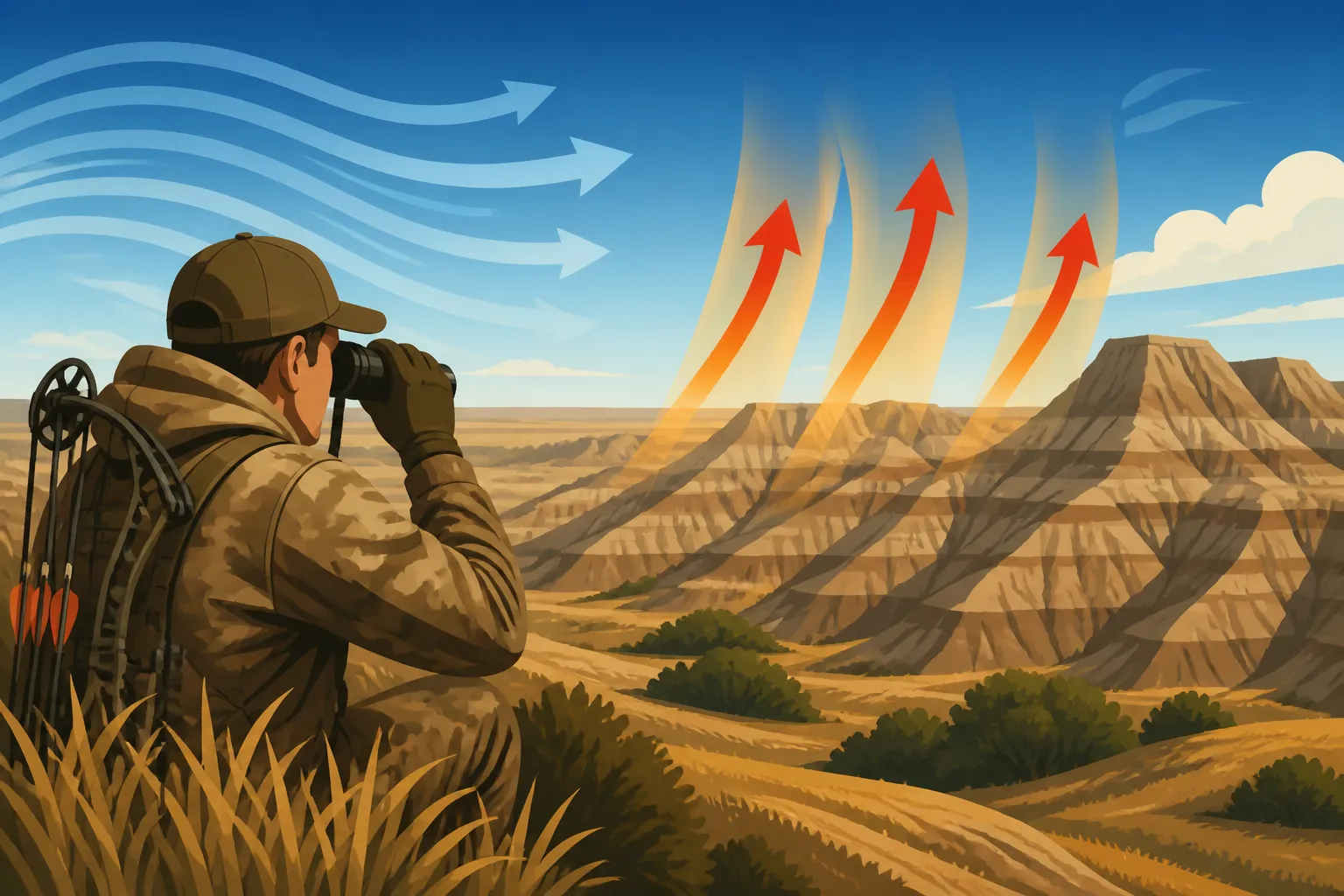
At its core, wind is simply air moving horizontally across the Earth's surface, usually from high-pressure areas to low-pressure areas. Thermals, however, are vertical air currents caused by temperature differences. As the sun rises and warms the earth, air heats up and begins to lift, creating an updraft. Conversely, as the sun sets and the ground cools, the air cools and sinks, forming a downdraft. On flat land, these patterns are relatively consistent: updrafts during the day, downdrafts at night. But in the Badlands, nothing is truly flat, and these predictable patterns get constantly interrupted and redirected.
Think about how sunlight hits the terrain. South-facing slopes warm faster than north-facing ones, creating microclimates that influence local thermals. A shaded draw might hold cool, stagnant air even when a nearby ridge is baking in the sun. This creates a patchwork of rising and falling air that can be incredibly difficult to predict, especially if you're not paying close attention to the specific contours and sun exposure of your immediate surroundings. This is where tools like GoHunt can be invaluable, offering detailed topographical maps that help you visualize these elements.
How Badlands Topography Influences Air Currents
The Badlands are a maze of sharp ridges, deep coulees, and winding draws, and each of these features acts like a natural funnel or barrier for air. Wind that might be blowing consistently from the west at 20 mph over a high plateau can be completely swirling in a deep coulee just a few hundred yards away. You might feel a gentle breeze on your face, only to find that your scent is being carried directly into a bedding area by a localized downdraft you didn't even register.
For instance, when Hunting a Badlands Draw for Mule Deer, you'll quickly realize that the draw itself can create a wind tunnel effect, channeling air in unexpected directions. On the other hand, a broad, flat plateau might offer more consistent wind direction, but even then, the edges where it drops off into a valley can cause significant turbulence. Understanding that every rise and fall in this landscape affects air movement is paramount. The air here doesn't just flow over; it gets pushed, pulled, and swirled around every obstacle, creating micro-eddies and currents that can be a hunter's worst nightmare if not accounted for.
Reading the Air in the Field
Knowing the theory is one thing, but applying it in the rugged, real-world conditions of the North Dakota Badlands is where the rubber meets the road. Hunters often find themselves scratching their heads, wondering why their carefully planned approach went sideways because of a fickle breeze. Learning to truly "read the air" in this complex terrain is a skill that takes practice, but it's one that will drastically increase your odds of success.
Using Visual Cues and Scent Checkers
The most basic, yet often overlooked, way to read the wind is by paying attention to visual cues. Watch the movement of grass, leaves on sparse shrubs, or even dust motes in the air. Carry a small, lightweight string or a squeeze bottle of scentless powder to constantly check the wind direction at your exact location, especially when you're moving through different elevations or navigating complex terrain. A quick puff of powder at different heights can reveal layers of air movement you wouldn't otherwise perceive. This is particularly crucial when you're trying to figure out Where Badlands Bucks Bed. They'll often pick beds with tricky wind currents to give them an advantage.
Don't just check the wind once; make it a habit every few minutes, especially when you pause, change direction, or enter a new micro-terrain feature like a small gulch or the backside of a hill. What you felt at the top of a ridge might be completely different in the bottom of a coulee. The subtle movement of a spider web or the ripple on a tiny puddle can tell you more than a weather app ever could about the localized conditions impacting your hunt.
The Thermal Cycle and Its Daily Impact
The thermal cycle is your daily clock in the Badlands. In the early morning, as the sun barely peeks over the eastern ridges, the air in the valleys and draws often holds cold, dense air, causing downdrafts. This means your scent will be pushed downhill and into lower elevations. This is a prime time to hunt ridges or work your way up a draw, keeping your scent from dropping into bedding areas below.
As the sun climbs higher, warming the slopes and plateaus, those downdrafts will gradually transition to updrafts. This shift typically occurs a few hours after sunrise, though the exact timing varies based on cloud cover, humidity, and the steepness of the terrain. During the peak of the day, thermals will generally rise, pulling your scent uphill. This is when you might want to hunt lower, trying to catch deer moving up from bedding areas, or position yourself above your target.
Then, as evening approaches and the sun dips, the cycle reverses. The land cools, and downdrafts begin to dominate again, pushing air back down into the valleys. This is often an ideal time to hunt the bottoms of draws or work down from ridges, as your scent is carried away from animals moving into feeding areas in the lowlands. Being keenly aware of this ebb and flow, even subtle changes, is vital for success, especially if you're engaged in intense physical exertion while trying Physical Prep for Badlands Elk Terrain.
Here's a simplified look at the thermal cycle in Badlands terrain:
| Time of Day | Dominant Airflow | Scent Movement | Ideal Hunting Strategy |
|---|---|---|---|
| Early Morning | Downdrafts | Downhill, into low areas | Hunt high, approach from above, work up draws. |
| Mid-Morning (Transition) | Swirling, unstable | Unpredictable | Exercise extreme caution, re-evaluate often. |
| Midday (Peak Sun) | Updrafts | Uphill, out of low areas | Hunt low, approach from below, stalk ridges. |
| Late Afternoon (Transition) | Swirling, unstable | Unpredictable | Adapt quickly, prioritize observation. |
| Evening/Night | Downdrafts | Downhill, into low areas | Hunt low, approach from above, ambush at water/food. |
Tactical Adaptations for Badlands Hunting
Knowing how wind and thermals behave is powerful, but it’s only truly useful if you can translate that knowledge into actionable hunting strategies. The Badlands demand flexibility and constant awareness, forcing hunters to think on their feet and adapt their tactics to the ever-changing air currents. This section dives into practical ways to use this insight to your advantage.
Stalking and Approaching Game Effectively
When you're trying to put a stalk on a mule deer in the Badlands, your approach needs to be meticulously planned around the wind and thermals. Never assume the wind on the ridge you're currently on is the same as in the coulee where the deer is bedded. Before making any move, especially when Hunting North Dakota's Badlands Mule Deer Country, always get a reading of the wind at your current elevation and try to anticipate how it will shift as you descend or ascend.
If you're dealing with a midday updraft, you might be able to approach from below your target, using the rising air to carry your scent over them. However, if the sun is setting and downdrafts are starting, a similar approach would send your scent directly to them. Sometimes, the best approach might not be the most direct one. You might have to make a wide loop, gaining elevation to come in above a draw with a downdraft, or skirting around a plateau to avoid a turbulent wind eddy. This is where detailed topographic maps and tools like GoHunt become invaluable for pre-planning your route, allowing you to visualize potential wind funnels and thermal traps.
Setting Up Ambushes and Stand Locations
For hunters who prefer to sit and wait, choosing the right ambush point in the Badlands is a delicate dance with the wind. Whether you're waiting near a water source, a travel corridor, or a food plot, your primary concern must be ensuring your scent doesn't betray you. This is especially true when you're targeting those elusive mature bucks that thrive in areas of Badlands Deer Density.
When setting up for a morning hunt, consider locations that are slightly above where you expect deer to be moving. As those early downdrafts push your scent downhill, it will ideally be carried away from their path. Conversely, in the evening, when thermals are reversing to downdrafts, setting up below a ridge line that deer use to travel between bedding and feeding areas can be very effective.
Consider this scenario: You've located a promising travel corridor along the bottom of a coulee. In the morning, you might position yourself on the side of the coulee, slightly up the bank, so your scent blows down and away from the deer moving through. As the day progresses and thermals shift, that same spot might become a liability. You might need to move to the opposite bank or a higher vantage point for an evening sit. This constant mental re-evaluation is key to hunting successfully in this dynamic environment. Even if you're trying to Glassing Badlands Coulees for Elk, understanding where your scent is going allows you to stay hidden while observing.
Adapting to Shifting Conditions and Unpredictable Gusts
One of the biggest challenges in the Badlands is the sheer unpredictability of the wind. A calm morning can quickly turn into a gusty afternoon, and a seemingly consistent breeze can start swirling without warning in a deep ravine. It's not uncommon to experience multiple wind directions within the span of a few minutes, particularly in the mid-morning and late-afternoon transition periods of the thermal cycle. This is why having multiple stand or ambush options, or at least a flexible plan, is critical when Hunting the North Dakota Badlands.
When the wind starts to become truly erratic, sometimes the best strategy is to become the "ghost" of the Badlands. Slow down. Use the terrain to your advantage, stalking into the wind as much as possible, always using cover. Take frequent pauses to re-check the wind and reassess your approach. If the wind is truly swirling, it might be safer to back out and reposition, or even call it a day in that particular spot and move to a different area with more predictable air currents.
Remember, deer and other game animals rely heavily on their sense of smell, and they are incredibly adept at using the wind to their advantage. To succeed in the Badlands, you must become just as good at reading and using the wind as they are. Utilizing modern tools like detailed topographical maps, frequently checking wind direction with visual aids, and having an understanding of the daily thermal cycles will stack the odds in your favor against the wild, untamed air of this incredible landscape. Understanding these nuanced movements is just one part of the puzzle that makes Why Badlands Units Produce Big Bucks year after year – hunters who learn to adapt often find the most success. For hunters preparing for other challenging hunts, knowing how to interpret air currents is an essential skill, much like understanding North Dakota Mule Deer Migration Corridors or Reading Aerial Photos for Badlands Deer. You can also apply these insights when Hunting a Coulee on Little Missouri Grassland to help you plan your entry and exit.
Disclaimer
Hunting is an inherently dangerous activity. This guide provides information for educational purposes only and does not endorse unsafe practices. Always consult the latest North Dakota hunting regulations, obtain proper licenses, and prioritize safety in the field. Be aware of your surroundings, hunt ethically, and respect private property.