Still-Hunting North Dakota’s Missouri River Bottomland
Hunting the dense, often unpredictable Missouri River bottomlands in North Dakota can feel like trying to find a needle in a haystack—or more accurately, a trophy buck in a tangle of willows and cottonwoods. This isn't wide-open prairie where you can glass for miles; it's a claustrophobic, often wet, and challenging environment that frustrates many hunters accustomed to different terrains. This guide will walk you through the art of still-hunting these unique river corridors, focusing on how to move slowly, read the subtle signs, and effectively pursue deer in an area that demands patience and a keen understanding of their movements.
Understanding the Missouri River Bottomland Ecosystem for Still-Hunting
The Missouri River in North Dakota carves a distinct and vital habitat corridor, vastly different from the surrounding prairie. Still-hunting here means understanding this unique environment and how deer thrive within its confines. It’s not just about trees; it’s about water, varied vegetation, and how all these elements combine to influence deer behavior.
The Unique Habitat and Its Challenges
The Missouri River bottomland is a tapestry of life, but it presents significant challenges for hunters. You'll encounter dense stands of cottonwood, willow thickets so thick they form a nearly impenetrable wall, and pockets of ash and elm, all interspersed with sloughs, oxbow lakes, and often muddy terrain. This isn't neat, manicured forest; it's wild and often chaotic. The ground can be soft and squishy from recent rains or snowmelt, making silent movement incredibly difficult. Tangled undergrowth, downed timber, and hidden ditches are constant obstacles. The sheer volume of cover means deer can be just feet away, totally unseen. This isn't a place for fast movement; it demands a methodical, almost agonizingly slow pace. The river itself creates microclimates and influences vegetation patterns, often providing a consistent water source and lush forage even when the surrounding prairie is dry.
One of the biggest frustrations is the feeling of being "in the deer," but not seeing them. They have an uncanny ability to disappear into the heavy cover, often slipping away long before you even know they were there. The density of the vegetation also limits sight lines to mere yards, forcing you to hunt with your ears and nose as much as your eyes. This is where patience becomes your greatest asset, pushing through the urge to speed up and cover more ground, knowing that every single step needs to be deliberate and quiet. Understanding Reading a Missouri River Bottom for Deer is crucial to breaking down this complex habitat.
How Deer Utilize River Bottom Cover
Deer in the Missouri River bottomlands are masters of concealment, using the dense cover to their absolute advantage for bedding, feeding, and travel. During daylight hours, especially when hunting pressure is high, they'll often bed down in the thickest willow or dogwood tangles, near water sources or along the edges of small sloughs where they feel secure. These areas provide excellent thermal cover in harsh North Dakota winters and shade during warm early-season hunts.
Their travel routes are typically well-defined trails, often forming natural funnels between bedding areas and food sources. These trails can be subtly etched through the undergrowth or wide paths worn down by generations of deer. They'll hug creek banks, follow old oxbow lake edges, or move along the fringes of denser timber patches. Food sources are abundant, from browse on young willows and dogwoods to acorns in the pockets of oak that sometimes appear, or even agricultural fields bordering the river. Deer will often stage in the heavier timber just inside the field edge before moving out to feed at dusk. Knowing these patterns means you're not just wandering aimlessly; you're actively looking for specific types of cover and movement corridors, maximizing your chances of encountering a deer within those tight windows of opportunity.
Seasonal Changes and Their Impact on Movement
The Missouri River bottomland is a dynamic environment, and deer movement changes dramatically with the seasons. Early archery season, when leaves are still thick, is perhaps the most challenging for still-hunting. Visibility is minimal, and deer can move almost undetected. Focusing on water sources and early-season food like lush browse or secluded forbs becomes key. As fall progresses into October and leaves begin to drop, visibility improves, making still-hunting slightly less daunting. This is when the rut begins to pick up, and bucks start cruising more, rubbing trees and making scrapes, offering better opportunities.
The late season, especially during rifle and muzzleloader hunts, transforms the bottomland. After heavy frosts or snow, much of the undergrowth dies back, and leaf litter covers the ground. While visibility improves dramatically, quiet movement becomes incredibly difficult as dry leaves crunch underfoot. Deer, however, will often be concentrated in the thickest cover for warmth and shelter, often near late-season food sources like standing corn or alfalfa fields adjacent to the river. Tracking in fresh snow also becomes a viable still-hunting tactic, making it easier to follow their paths and approach quietly. Understanding how Late-Season Food Sources for North Dakota Whitetails influence their patterns can be a game-changer when leaves are off the trees. The river itself might freeze over, creating new travel corridors or cutting off old ones, requiring constant adaptation from the hunter.
Essential Gear and Preparation for Still-Hunting
Still-hunting the Missouri River bottomland requires more than just a rifle and a tag; it demands a specific approach to gear that prioritizes stealth, comfort, and the ability to navigate complex terrain. Being prepared before you even set foot in the woods makes all the difference.
Clothing and Footwear for Stealth and Comfort
Your clothing and footwear are arguably the most critical components of still-hunting success. The goal is silence and protection from the elements. Layering is paramount in North Dakota's unpredictable weather, allowing you to adjust to changing temperatures without rustling. Opt for soft, quiet fabrics like fleece, wool, or brushed cotton, avoiding anything that makes noise when you move or brushes against branches. Scent control is also a major factor here, so choose garments designed to minimize human odor.
Footwear needs to be waterproof and provide excellent ankle support, as you'll be traversing uneven, often muddy ground, negotiating downed timber, and crossing small sloughs. Rubber boots are often preferred for their waterproof qualities and scent-free properties, but ensure they are comfortable enough for long, slow walks. Many hunters favor a quality pair of knee-high rubber boots for wading through shallow water and keeping dry. The fit is crucial; boots that are too loose will cause blisters, and those that are too tight will cut off circulation, leading to cold feet. Remember, quiet steps are paramount, so practice walking silently in your chosen boots before your hunt.
Optics and Navigation Tools
In the dense river bottom, while long-range optics might seem less critical than in open country, quality binoculars are still indispensable. They allow you to scrutinize every patch of cover, identify subtle deer parts through the foliage, and confirm movement without having to shift your body, which can often spook game. A good pair of 8x or 10x binoculars, rugged and waterproof, will serve you well. A rangefinder is also wise, as distances can be deceiving in heavy cover, and shots might present themselves quickly at varying ranges.
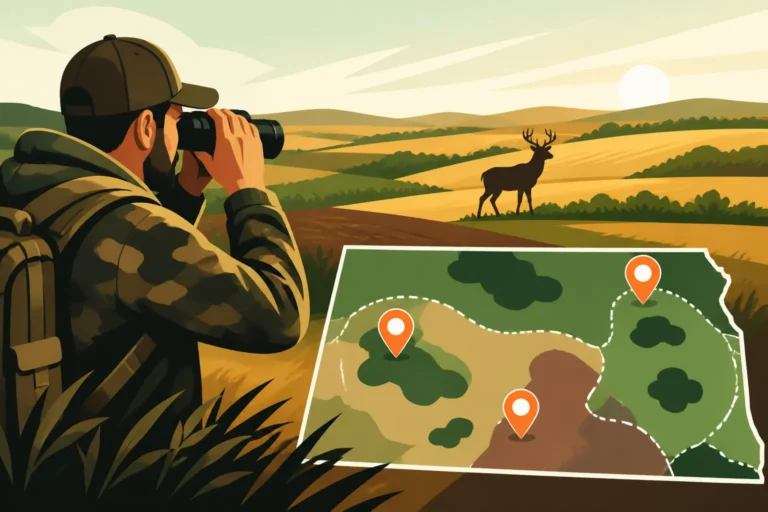
Navigation is paramount to staying found and efficient in the often disorienting bottomlands. A reliable GPS unit or a smartphone with a hunting app like GoHunt's mapping features is essential. These tools allow you to mark potential bedding areas, food sources, and even your still-hunting path, helping you maintain a bearing and relocate specific features. You can also use them to identify property lines, especially if you're Hunting North Dakota Wildlife Management Areas or other public parcels that might be bordered by private land. Always carry a physical map and compass as a backup, and know how to use them. Cell service can be spotty along the river, so downloaded maps are a must.
Weapon Choice and Carrying Considerations
When still-hunting dense river bottomland, your weapon choice and how you carry it heavily impact your effectiveness. For rifle hunters, a lighter, more compact rifle is often preferred, making it easier to maneuver through thick brush without getting snagged. Shorter barrels are a distinct advantage. If you're bowhunting, a compact bow is similarly beneficial. Regardless of weapon, ensure it's sighted in precisely for the relatively short ranges you'll likely encounter.
The way you carry your weapon is crucial for quick, silent deployment. Slinging it over your shoulder might work in open country, but in the bottomland, it's a recipe for snags and noise. Many still-hunters prefer carrying their rifle or shotgun across their body, ready to shoulder instantly, or using a silent sling that keeps the weapon close and secure. For bowhunters, keeping your bow ready, either in hand or on a quiet sling, is vital for those fleeting shot opportunities. Practice bringing your weapon to bear silently and smoothly from various carrying positions. The last thing you want is a missed opportunity because you were wrestling with your gear.
Mastering Still-Hunting Techniques in Timber
Still-hunting is more an art than a science, especially in the tight confines of Missouri River bottomland timber. It requires an almost meditative pace, sharp observation skills, and a deep understanding of how deer interact with their environment. It’s about being part of the woods, not just moving through them.
The Art of Slow Movement and Observation
This is the cornerstone of successful still-hunting. Forget covering ground quickly; your pace should be measured in yards per minute, not miles per hour. A good rule of thumb is to take no more than five to ten steps, then stop for several minutes to scan, listen, and simply observe. This stop-and-go cadence allows you to spot deer that might have been screened by a tree or brush with your previous step. When you stop, don't just stare blankly; methodically scan from side to side, up and down, looking for horizontal lines in a vertical world, a flicker of an ear, a patch of brown hide that doesn't quite match the timber. Use your binoculars to pick apart dense cover.
Listen intently for the subtle sounds of the forest—the rustle of leaves that isn't wind, a snapped twig, the distant snort or grunt. The dense bottomland timber often muffles sound, so you need to be acutely tuned in. The slower you move, the more likely you are to see deer before they see you, giving you precious seconds to assess the situation, plan your shot, or even adjust your approach. Remember, deer are constantly alert; your goal is to break down their sensory advantage by being even more patient and observant than they are.
Reading Wind and Thermals in Bottomland
Wind and thermals are your invisible allies or worst enemies in the Missouri River bottomland. Unlike open prairie, wind currents here can be highly unpredictable, swirling and eddying through the timber, especially near the river itself or along the edges of steep banks. You must constantly monitor the wind direction, using a small puffer bottle with powder or a piece of milkweed silk. Always try to hunt with the wind in your face or quartering into it, carrying your scent away from where you expect deer to be.
Thermals, the rising and falling air currents, also play a significant role. In the morning, as the sun warms the earth, thermals rise, carrying scent upwards. In the evening, as the air cools, thermals fall, carrying scent downwards. This means an entirely different hunting strategy depending on the time of day and the topography. Hunting uphill in the morning can be effective, as your scent will rise above the deer. Conversely, hunting downhill in the evening can be advantageous, as your scent will fall below them. Understanding these dynamics and adjusting your route and timing is critical to remaining undetected, especially when a mature buck's nose is the ultimate defense.
Utilizing Topography and Natural Funnels
Even in the relatively flat river bottom, subtle changes in topography create natural funnels that deer frequently use. Look for slight rises, old river oxbows that create natural corridors, or changes in vegetation density that concentrate deer movement. These funnels are prime locations for still-hunting, as they limit where deer can move, increasing your chances of an encounter. Creek crossings, pinch points between dense thickets and more open timber, or even elevated banks along the river itself can act as highways for deer.
Also, pay close attention to the transition zones where one type of cover meets another—for example, where a dense willow stand transitions into more open cottonwood timber, or where the river bottom meets a bordering agricultural field. Deer often use these edges for travel, feeding, and security. By still-hunting these natural funnels and transition areas, you're not just hoping to bump into a deer; you're actively positioning yourself in areas where their movement is most predictable. Think of these as nature's choke points, guiding deer where you want them to be. For more ideas on finding such areas, consider how you might apply lessons from Hunting a Shelterbelt Edge for Deer to these riverine environments.
Scouting and Locating Key Areas for Success
Effective still-hunting begins long before you step foot in the woods with your weapon. Thorough scouting, both pre-season and even during the hunt, is paramount to understanding deer patterns in the challenging Missouri River bottomland. Without it, you're essentially walking blind, hoping for luck.
Identifying Primary Food Sources and Bedding Areas
Knowing what deer are eating and where they're resting is the foundation of any successful still-hunting strategy. In the river bottom, primary food sources can vary widely. Early season might see deer browsing on lush vegetation, forbs, and various shrubs found along the riverbanks or in clearings. As the season progresses, acorns, if present in any scattered oaks, become a highly sought-after food. Later in the season, deer will often move to agricultural fields bordering the river, such as standing corn, alfalfa, or soybeans. Look for deer trails leading into and out of these fields, as well as tracks and droppings in and around the food source itself.
Bedding areas are almost always located in the thickest, most impenetrable cover the bottomland offers. Think dense willow or dogwood thickets, tangles of downed timber, or even isolated islands within sloughs. These areas provide security, thermal cover, and a vantage point for deer to detect predators. Look for subtle deer beds, often just depressions in the leaves or grass. The closer you find bedding sign to a food source, the better, indicating a short, secure travel route for deer. Your goal is to identify these key areas, then plan your still-hunting route to intercept deer as they transition between them, or even to cautiously approach the edges of bedding areas without bumping them.
Decoding Deer Sign: Scrapes, Rubs, and Tracks
Deer sign is the language of the woods, and learning to read it effectively is crucial for still-hunting success. Fresh tracks can tell you not only that deer are present but also their direction of travel, how recently they were there, and sometimes even their size. Look for clusters of tracks along trails, near water, and around food sources. Buck tracks tend to be larger and more splayed, with larger dewclaws showing in soft ground, especially when they're moving at a relaxed pace.
Rubs, where bucks scrape their antlers against saplings and small trees, are indicators of buck presence and movement. Fresh rubs, with shiny wood underneath the bark, mean a buck is actively working the area. A "rub line" – a series of rubs leading in a specific direction – can reveal a buck's travel corridor. Scrapes, patches of bare earth pawed clear by bucks and urinated on, are communication hubs. Active scrapes, especially those with an overhanging branch broken and chewed, indicate a buck frequently visiting the spot. While Grunt Calls in River Bottom Timber can be effective, finding fresh sign helps you choose the right place to deploy them. The fresher and more numerous the sign, the higher the likelihood of encountering deer in that specific area. Using mapping apps like those from GoHunt can help you mark and analyze these signs, building a comprehensive picture of deer activity over time.
Using Technology for Pre-Season Planning
In today's hunting world, technology is an invaluable asset for scouting and planning, even for something as traditional as still-hunting. Satellite imagery and topographical maps, available through platforms like GoHunt, allow you to "scout from your couch." You can identify potential bedding cover (the darkest green blobs), travel corridors (lines of trees or changes in elevation), and food sources (agricultural fields, openings) long before you ever step foot in the woods.
Layers on these apps, like those that show OnX Layers for North Dakota Land Status or aerial photography, can help you pick out subtle features like old creek beds, hidden sloughs, or dense thickets that might hold deer. You can also identify public land boundaries, ensuring you're not trespassing. By dropping pins on potential spots of interest, marking historic deer sightings, or even recording your past still-hunting routes, you build a digital database that helps refine your strategy. This pre-season planning allows you to maximize your time in the field, focusing your efforts on the most promising areas rather than aimlessly wandering. It's a fantastic way to break down the vastness of the Missouri River bottom and make it feel more manageable.
Adapting Your Approach to Weather and Hunting Pressure
Still-hunting in North Dakota's Missouri River bottomland is rarely a static endeavor. Success often hinges on your ability to adapt your strategy to the ever-changing weather patterns and the presence of other hunters. Being flexible and responsive to these external factors can make or break your hunt.
Still-Hunting in Diverse Weather Conditions
North Dakota weather can be notoriously fickle, and the river bottom's microclimate can amplify these changes.
- Rain and Snow: Overcast, drizzly, or lightly snowy days are often fantastic for still-hunting. The moisture quiets leaf litter and softens the ground, making silent movement much easier. Deer also tend to move more during these periods, often feeling more secure with reduced human activity. In fresh snow, tracking becomes a primary still-hunting technique, allowing you to follow a buck's path and plan a cautious approach. However, heavy rain or snow can severely limit visibility and soak your gear, so be prepared with waterproof clothing.
- Cold Snaps: Following a significant cold front, deer will often be driven to feed more aggressively to build energy reserves, especially during the late season. They also seek the thickest cover for thermal protection. Focus your still-hunting efforts in these dense bedding areas or along routes leading to crucial Hunting Into a December Cold Snap food sources.
- Windy Days: High winds can be a double-edged sword. While the wind helps mask your sound and scent, it also makes it harder for you to hear deer, and deer themselves often become more nervous and bed down in sheltered areas. On windy days, focus on still-hunting the lee side of ridges, dense tree lines, or in deep draws where the wind's intensity is reduced. Deer will often choose these spots for comfort.
Handling Hunting Pressure on Public and Private Land
Hunting pressure is an unavoidable reality, especially on public land like parts of the North Dakota's Missouri River Corridor and adjacent North Dakota Wildlife Management Areas. Deer quickly learn to associate human activity with danger and will adjust their patterns accordingly. When pressure is high, deer become more nocturnal, moving primarily at dawn, dusk, or even throughout the night. They also seek out the thickest, most overlooked sanctuaries.
Your strategy in pressured areas needs to adapt. Instead of focusing on obvious travel routes, look for areas that other hunters avoid: the nastiest, thickest tangles, deep sloughs that require wading, or sections that are a long, difficult walk from access points. Still-hunt these overlooked pockets during midday when many hunters are back at camp or less active. Deer often lie up tight in these sanctuaries, only moving once evening approaches. If you have access to private land, be mindful of how your presence affects deer, and try to minimize disturbance. In these situations, your slow, quiet still-hunting approach is your greatest asset, allowing you to slip into areas without alerting deer to your presence, even if they've been bumped by others. Don't be afraid to put in the extra miles; deer know the difference between easy and hard access.
Post-Shot Strategies and Recovery
Successfully still-hunting a deer in the Missouri River bottomland is only half the battle; recovering it can be a significant challenge given the dense cover and often rugged terrain. After a shot, always give the deer ample time, especially if the shot wasn't immediately fatal. For a lung-shot deer, waiting 30-60 minutes is often sufficient, but for a gut shot, a wait of 4-6 hours, or even overnight, is crucial to allow the deer to bed down and expire. Pushing a wounded deer too soon can push it further into impenetrable cover, making recovery nearly impossible.
When you begin tracking, move slowly and deliberately. Look for blood, broken twigs, matted grass, and disturbed leaves. Mark your last known blood or sign with flagging tape (remember to remove it afterwards!) or your GPS to avoid losing the trail. If the blood trail peters out, expand your search in circles around the last sign. Deer often follow the path of least resistance, so look for natural openings, trails, or creek beds they might have taken. The dense cover that made still-hunting so challenging now makes tracking equally so. Consider utilizing a tracking dog if legal and available, especially for a tough trail. Once recovered, be prepared for the work of Field Dressing a Deer in Cold Weather and dragging it out, which can be a strenuous undertaking in this environment. Having a good game cart or a partner can make this much easier.
Disclaimer
Please be aware that hunting regulations and land access policies can change frequently. Always consult the latest North Dakota Game and Fish Department regulations and confirm land ownership and access before venturing out. This guide is for informational purposes only and should not replace official sources or responsible hunting practices.