Rattling and Decoying Prairie Pothole Bucks
One of the most thrilling and often frustrating aspects of hunting North Dakota’s vast prairie is trying to consistently bring a mature whitetail buck into range during the rut. These prairie pothole bucks can be elusive, often holding tight in cover or skirting around traditional stand setups. This comprehensive guide is designed to equip you with the knowledge and tactics to successfully use rattling and decoying to draw these wary animals right into your wheelhouse, turning those distant sightings into close encounters.
Understanding Prairie Pothole Bucks and Their Habitat
North Dakota’s prairie pothole region is a unique landscape, a mosaic of wetlands, grasslands, and agricultural fields. It’s a far cry from the dense timber stands often associated with deer hunting, and because of this, the deer behave differently. Successfully calling and decoying these bucks starts with a deep understanding of their world.
Behavioral Patterns on the Prairie
Whitetail bucks in the prairie pothole region develop a unique set of behaviors driven by their open environment. Unlike their timber-dwelling cousins who rely on thick cover for movement, these bucks often travel vast distances across open ground, especially during the rut. They become masters of using subtle topographical features like low rises, shelterbelts, and slough edges for concealment. You’ll often find them bedded down in dense cattails or tall grass, seemingly out in the middle of nowhere, only to emerge to check doe groups in adjacent fields. Their survival instinct in this open landscape means they are incredibly wary, constantly scanning for danger, making a convincing setup all the more crucial. Understanding their daily routines – when they move between bedding and feeding areas, and how they utilize those linear pieces of cover – is fundamental to placing yourself in a position for success.
Prime Rut Timing in North Dakota
The rut is undoubtedly the best time to employ rattling and decoying tactics for prairie bucks. While North Dakota’s archery season opens in early September, the true frenzy of the rut, when bucks are most susceptible to calling, typically occurs in early to mid-November. This aligns perfectly with the state’s gun season opener, offering a narrow but intensely productive window. Bucks are driven by the irresistible urge to breed, making them more reckless and curious. During this period, you’ll see an increase in scraping and rubbing activity, and bucks will be actively cruising for does. It's during this time that the illusion of a rival buck or a receptive doe becomes most potent. Keep an eye on the weather; a cold snap can often kick the rut into high gear, concentrating activity and making bucks more responsive to both visual and auditory cues. For specific dates and insights into the best periods, you'll want to review resources like Hunting the Rut in Early-to-Mid November.
Identifying Key Pothole Habitat
Prairie pothole bucks thrive in the diverse habitat offered by this region. Look for areas where wetlands (the "potholes") intersect with various forms of cover. Dense cattail sloughs provide excellent bedding and escape cover, while adjacent strips of willows, shelterbelts, or unharvested crops offer travel corridors and staging areas. Don't overlook large sections of CRP (Conservation Reserve Program) grass, which can hold surprising numbers of deer, especially mature bucks looking for undisturbed bedding. Agricultural fields, particularly corn or sunflower fields, serve as vital food sources, and bucks will frequent their edges, especially during the low light hours. Identifying where these elements converge – a cattail slough bordering a cornfield with a shelterbelt nearby – is paramount. This confluence of cover, water, and food creates natural pinch points and travel routes where your rattling and decoying efforts will be most effective. A careful study of satellite imagery, perhaps using a tool like GoHunt, can help you pinpoint these critical intersections before you even step foot in the field.
The Art of Rattling Deer in Open Country
Rattling is essentially mimicking a deer fight, a challenge that bucks, especially during the rut, often can't resist investigating. Doing it effectively on the open prairie requires a different approach than in dense woods.
Choosing the Right Rattle Bag or Antlers
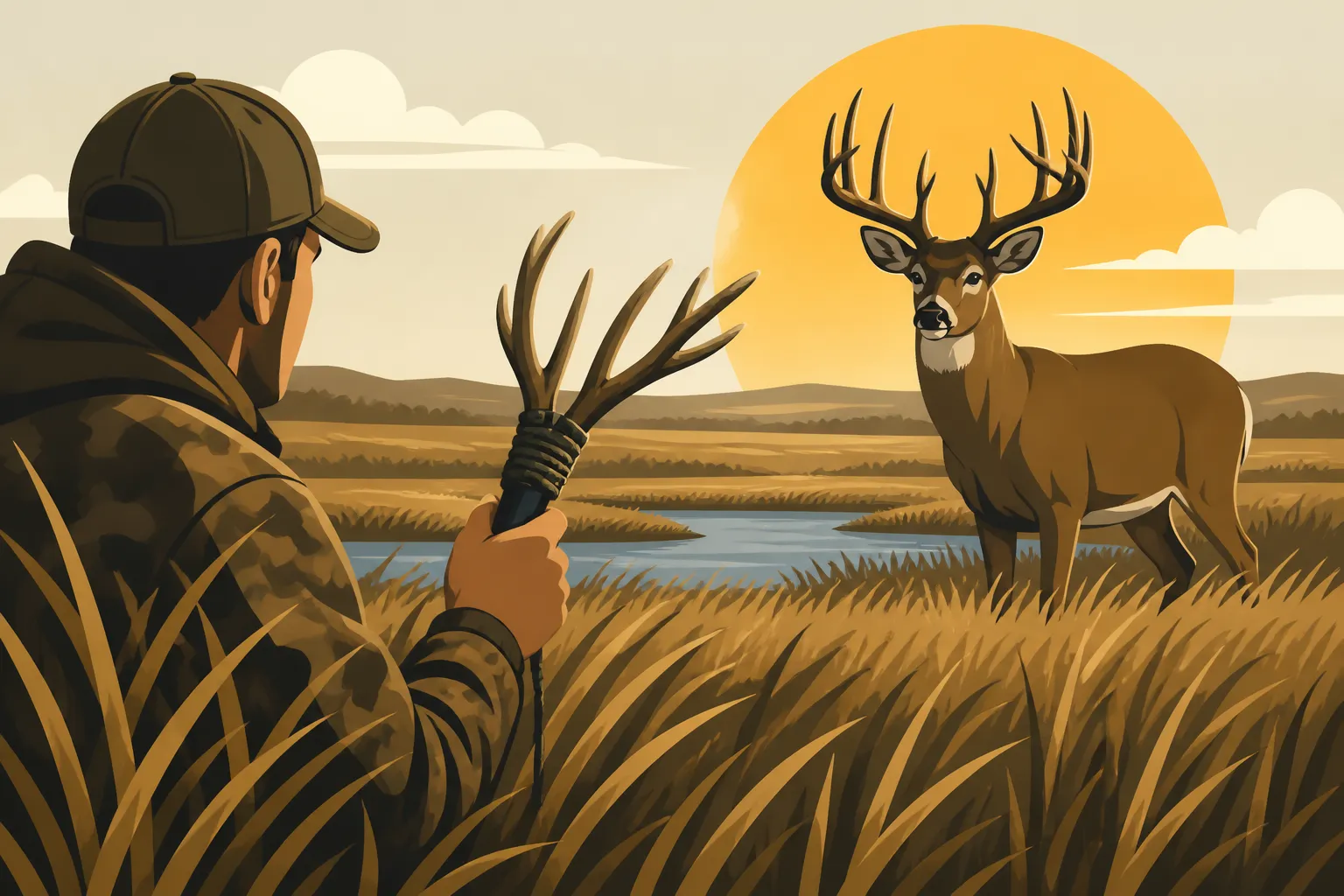
When it comes to rattling, you have a few options, each with its pros and cons. Real antlers offer the most authentic sound. A good set of shed antlers from a mature buck will give you the clashing, grinding, and breaking sounds that mimic a genuine fight. However, they can be bulky and noisy to carry through cover. Rattle bags, on the other hand, are much more portable and convenient. They consist of wooden or synthetic rods inside a fabric bag, allowing you to create various sounds with minimal effort. While some hunters argue they don't produce the exact sound of real antlers, modern rattle bags like those from Primos or Knight & Hale are quite good and can be very effective. The key is to practice with whatever you choose, ensuring you can produce a range of sounds from light sparring to an all-out brawl, complete with grunts and snort-wheezes. The volume and intensity of your rattling sequence are particularly important on the open prairie where sound can carry for miles.
Techniques for Sounding Natural
Making your rattling sequence sound natural is critical. On the open prairie, sound travels far, and an unnatural series of crashes will send more deer running than coming in. Start with light sparring, two bucks feeling each other out. This might involve a few gentle clicks and rubs. If no response, escalate to a more aggressive clash, incorporating grunts, and even a snort-wheeze if you have a call. A full-blown fight often involves about 30 seconds to a minute of intense antler clashing, followed by a minute or two of silence, and then repeating. Remember to incorporate pauses, as real fights aren't continuous. Also, scrape the ground with your foot or a stick to mimic pawing, and break small branches to simulate the surrounding brush being disturbed. This adds to the realism. Keep your head on a swivel during the pauses; curious bucks will often approach cautiously, trying to pinpoint the source of the sound before fully committing. For more on volume, consider checking out Rattling Volume on the Open Prairie.
When and Where to Rattle
The "when" and "where" are just as important as the "how" when rattling. The peak of the rut, typically late October through mid-November in North Dakota, is the prime time when bucks are most aggressive and responsive. Early mornings and late afternoons, when bucks are naturally most active, are generally the best periods. However, don't rule out midday during the rut, as bucks will still be cruising. As for "where," focus on areas that offer at least some degree of cover, even if it’s just a slight rise, a tall grass field edge, or a lone shelterbelt. You want to give the approaching buck a reason to come closer, investigating the sound from downwind or crosswind. Avoid rattling from wide-open spots with no cover, as bucks are less likely to expose themselves. Position yourself so the sound carries effectively, but also so you have good visibility of potential approach routes. Setting up on the downwind side of a known travel corridor or bedding area can put you in an ideal spot to intercept a curious buck trying to scent-check the "fight."
Effective Decoy Strategies for Pothole Bucks
Decoys add a crucial visual element to your calling, often sealing the deal for a wary buck that might hesitate at sound alone. On the prairie, the right decoy strategy can be a game-changer.
Types of Decoys and Their Purpose
There are generally two main types of deer decoys used for bucks: buck decoys and doe decoys.
- Buck Decoys: These are designed to appeal to a dominant buck's territorial and competitive instincts. A smaller, less imposing buck decoy (like a yearling or 1.5-year-old buck) can often be more effective than a giant, aggressive one. A dominant buck might be intimidated by a huge rival, but he'll readily approach a smaller, "intruding" buck to assert dominance. Pose the buck decoy with its head down, body angled slightly away, as if it's feeding or challenging. This non-confrontational, yet present, posture can draw a real buck in without alarming it.
- Doe Decoys: These work on a buck's breeding instinct. A standing doe in a receptive posture can be incredibly enticing. Some doe decoys even feature a removable tail that can be moved to simulate a "wagging" action, signaling estrus. Often, combining a submissive buck decoy with a doe decoy, creating a small "scrape scene," can be highly effective. The doe attracts the buck, and the smaller buck provides a perceived rival to assert dominance over. Brands like Montana Decoy offer lightweight, foldable options perfect for packing into remote prairie locations.
Consider the time of year and specific rut phase when choosing your decoy. Early rut, a smaller buck decoy might be best. Peak rut, a receptive doe or a small buck/doe combo.
Optimal Decoy Placement
Placement is paramount, especially on the open prairie where deer have excellent long-range vision. The most common advice is to place your decoy directly downwind of your position, ideally 20-30 yards out, quartering away from you. This forces the approaching buck to come in front of you to scent-check the decoy, offering a broadside or quartering-away shot opportunity. On the prairie, however, deer often approach from a greater distance. You might need to place your decoy further out, up to 50-70 yards, to be seen from a distance and draw the buck closer.
Always consider the wind and thermals. A buck will almost always circle downwind to scent-check the "intruder" or "doe." Plan your setup so that the buck's approach path leads him past your shooting lane before he gets directly downwind of your actual hiding spot. Using natural cover, even a slight dip in the terrain or a patch of taller grass, to conceal your own movement until the shot is crucial. If you're setting up on a Setting Up on a Prairie Pothole Field Edge, consider the decoy placement to draw a buck off the field into your kill zone.
Scent Control and Realism
Even the best decoy and rattling sequence will fail if a buck smells human scent. Scent control is absolutely non-negotiable. Shower with scent-free soap, use scent-free laundry detergent for your hunting clothes, and store them in airtight bags or containers. Wear rubber boots to minimize scent transfer from your feet to the ground. Use scent eliminators generously, especially on your clothes and around your decoy. Additionally, consider using deer lures, such as estrus doe urine around your doe decoy or dominant buck urine near your buck decoy. These can add another layer of realism, especially if you have an older, less realistic decoy. However, be cautious with scents; too much or the wrong type can spook deer.
Beyond scent, ensure your decoy looks natural. Remove any unnatural shine or plastic glare. If using a foldable decoy, make sure it’s properly assembled and doesn’t flap in the wind. On windy North Dakota days, this can be a real challenge. You want the decoy to appear as lifelike as possible from a distance, drawing the buck in for a closer inspection.
Combining Rattling and Decoys for Maximum Impact
The true power lies in the synergy of rattling and decoying. Used together, they create a compelling illusion that is incredibly difficult for a rutting buck to ignore.
Synchronizing Sounds and Visuals
When you’re combining rattling and decoying, synchronization is key. Imagine two bucks fighting over a doe. The sounds aren't random; they emanate from the vicinity of the deer. Your rattling sounds should appear to come from where your decoys are positioned, or very close to it. If your decoys are 40 yards out and you're rattling from 20 yards behind them, a smart buck will immediately detect the disconnect.
Ideally, position yourself slightly upwind and behind your decoys, within comfortable shooting range. When you initiate a rattling sequence, visualize the fight happening at the decoy location. Incorporate aggressive grunts and snort-wheezes as you clash antlers. As you cease rattling, remain vigilant. Bucks often circle downwind, so be ready for an appearance from any direction. The decoy provides the visual confirmation that the sounds are real, pulling the buck’s focus away from your hidden position and onto the perceived rivals or receptive doe. This combination is especially potent when Hunting a North Dakota Prairie Pothole Slough Edge, as the linear cover helps funnel the deer into your setup.
Setting Up for the Shot
This is where all your preparation culminates. Once you've started rattling and your decoys are in place, your focus shifts to the shot. First, consider your concealment. On the open prairie, a portable ground blind like those from Ameristep or Barronett Blinds can be invaluable. It offers excellent concealment and allows for movement without being detected. Alternatively, utilize natural terrain features like a small depression, a cluster of brush, or even the thick edge of a cattail slough. Ensure you have clear shooting lanes to your decoy and all likely approach routes.
When a buck responds, he’ll often approach cautiously, stopping multiple times to assess the situation. Let him commit. Don't draw your bow or shoulder your rifle too early. Wait until his attention is fully fixed on the decoys and he’s within your comfortable shooting range. A buck will typically approach the decoy from downwind, circling to get a whiff. This is your opportunity. As he presents a broadside or quartering-away shot, make your move deliberately and quietly. Many hunters prefer to set up with their back to a thicker piece of cover, like a shelterbelt or a deep ditch, to break up their silhouette and prevent anything from getting behind them unseen.
Common Mistakes to Avoid
Even experienced hunters can fall prey to common mistakes when rattling and decoying.
- Over-Rattling: Too much rattling, or rattling too aggressively without a break, can sound unnatural and spook deer. Vary your sequences and incorporate periods of silence.
- Poor Scent Control: As mentioned, neglecting scent control is a deal-breaker. A buck’s nose is his primary defense.
- Impatience: Bucks rarely come charging in like a bull in a china shop. They often approach cautiously, taking their time. Give each setup at least 30-45 minutes before moving. Sometimes, a buck will respond silently, appearing seemingly out of nowhere a good while after your last rattle sequence.
- Decoy Placement: Placing decoys too far from your position (out of shooting range) or directly upwind (so the buck smells you first) are common errors.
- Wrong Decoy Pose: A buck decoy with an overly aggressive, head-up posture can deter smaller or equally dominant bucks. A submissive, quartering-away pose is generally more effective.
- Ignoring Wind/Thermals: Always play the wind. Period. A buck will always try to get downwind of the source of the sound or visual to confirm what he's seeing. Plan for this approach.
- Lack of Concealment: On the open prairie, you are exposed. Even a small ground blind can make a huge difference in breaking up your outline and allowing you to draw or raise your firearm. Consider Using a Ground Blind on PLOTS Land for maximum effect.
By understanding and avoiding these pitfalls, you'll significantly increase your chances of success.
Reading the Conditions and Adjusting Your Tactics
North Dakota's weather and hunting pressure can change on a dime, making adaptability crucial for successful rattling and decoying.
Wind Direction and Thermal Considerations
Wind is the single most important factor to consider when setting up for rattling and decoying, especially in open prairie country. A deer's sense of smell is incredibly acute, and they use the wind to their advantage. You must position yourself so that any approaching deer cannot get directly downwind of your position without first passing through your shooting lane. This often means setting your decoys downwind of your position, forcing the buck to circle, and giving you an opportunity.
Thermals, while often associated with mountainous terrain, also play a role on the prairie, particularly around coulees, river bottoms, and during sunrise and sunset. In the morning, cold air drains downwards, meaning your scent will fall into low-lying areas. In the evening, warm air rises, carrying your scent upwards. Understanding these subtle shifts allows you to place your setup to use the rising or falling air currents to your advantage, keeping your scent from being carried directly into a buck's nose. Always factor in how the prevailing wind and localized thermals will carry your scent. GoHunt's mapping features can often overlay wind direction, helping you visualize potential approach angles.
Pressure and Buck Response
Hunting pressure is another huge factor influencing how prairie bucks respond to rattling and decoying. During the first few days of the gun season, for instance, bucks may be more wary due to increased human activity. Heavily pressured areas will often see bucks become "nocturnal," moving primarily under the cover of darkness. In these situations, your rattling and decoying tactics need to be more subtle. Instead of aggressive, prolonged rattling sequences, try lighter sparring, or focus more on the visual appeal of the decoy with minimal calling.
Conversely, in areas with less pressure, especially on private land or less-accessed North Dakota PLOTS Land, bucks might be more aggressive and responsive. They haven't been educated by constant human encounters. This is where you can be more ambitious with your rattling, perhaps trying a more intense fight sequence. Pay attention to signs of pressure like numerous boot tracks, discarded shells, or deer acting skittish at long distances. If you're seeing a lot of deer, but they're acting extremely cautious, scale back your rattling intensity.
Post-Cold Front Tactics
North Dakota winters can be brutal, and a significant cold front often brings dramatic changes to deer behavior. After a hard prairie winter, deer may be focused primarily on feeding, and while the rut instincts are still there, the immediate need for calories might outweigh some of the breeding aggression. However, a fresh cold front during the rut can actually ignite buck activity. Dropping temperatures and fresh snow can make bucks feel more energetic and trigger more intense cruising for does.
In the immediate aftermath of a cold front, when temperatures plunge, deer might move earlier and later in the day to take advantage of available warmth, or hunker down in dense cover during the coldest hours. This is an excellent time for rattling and decoying, as bucks will be more visible and more driven to find receptive does. They’ll also be more inclined to check out any perceived rival activity. Be prepared for colder conditions yourself, utilizing a Cold-Weather Sitting Strategy on the Prairie to stay comfortable and alert. This combination of cold, clear weather and rutting activity often makes for some of the most exciting decoying and rattling encounters.
Gear and Set-Up Essentials for Success
Having the right gear and knowing how to use it efficiently in the field can make all the difference when pursuing prairie bucks with rattling and decoys.
Portable Blinds and Concealment
On the vast, open expanses of the prairie, natural cover can be scarce. This makes portable ground blinds an invaluable tool for rattling and decoying. Brands like Primos, Ameristep, and Barronett Blinds offer lightweight, quick-setup options that provide excellent concealment. They break up your silhouette, hide your movements, and help contain your scent. Look for blinds with shoot-through mesh windows that offer wide fields of view.
When setting up your blind, consider the sun's position. You don't want to be staring directly into the sun, nor do you want the sun glinting off your blind, potentially spooking a deer. Position the blind with your back to the sun if possible. Brush in your blind extensively using local vegetation like cattails, prairie grass, or willow branches. The more it blends into its surroundings, the less likely a wary buck will notice the unnatural object. Remember, a blind also offers protection from the relentless North Dakota wind, which can make a long sit much more tolerable.
Optics for Long-Range Scouting
North Dakota’s open terrain demands quality optics. Bucks can be spotted from extreme distances, and being able to identify deer, assess their antler size, and observe their behavior from afar is critical before committing to a rattling and decoying setup. High-quality binoculars (10×42 or 12×50) are essential for scanning fields and distant cover. A spotting scope with a tripod can be incredibly useful for examining deer hundreds of yards away, allowing you to discern if a buck is mature enough to be interested in your setup, or if it's even a buck worth pursuing.
Brands like Vortex, Leupold, and Zeiss offer excellent options across various price points. Don’t skimp on optics; they are your eyes in this expansive landscape. Use them to scan potential bedding areas, observe travel corridors, and confirm the presence of deer before you ever think about rattling. Often, you'll spot deer far away, and good optics will allow you to determine if they are moving in a direction that might bring them into range of a setup, or if you need to reposition entirely. Tools like GoHunt can provide topographic and land ownership maps to help you plan your glassing strategy.
Transporting Your Gear
Prairie hunting often involves significant walking, especially on public land like the North Dakota PLOTS Land or sections of the North Dakota's Prairie Pothole Region Explained. You might be hiking a mile or more to get to your desired setup location, carrying your rattling antlers, decoy, blind, and other essentials. A good quality hunting backpack is a must-have. Look for one that can comfortably carry your gear, distribute weight evenly, and has external straps or pockets for securing bulky items like a folded decoy or rattling antlers.
Consider using a game cart if you expect to be successful and have to retrieve a deer from a long distance. While they can be cumbersome on uneven terrain, a cart can save your back and make the extraction process much easier, especially for a large prairie whitetail. If you're hunting near a section road or ATV trail, an ATV or UTV can drastically reduce travel time and effort, allowing you to access more remote areas. Just be mindful of regulations regarding motorized vehicle use on public lands. Planning your entry and exit routes, especially when dealing with decoys and a ground blind, is a crucial part of the setup.
Table: Rattling and Decoy Tactics for Prairie Bucks
| Tactic | When to Use | Ideal Placement | Key Considerations |
|---|---|---|---|
| Rattling | Peak Rut (Late Oct-Mid Nov) | Near cover, slight rise, downwind of bedding/travel | Vary intensity, include grunts, silent pauses, watch downwind |
| Buck Decoy | Peak Rut, early rut (dominant buck response) | 20-40 yards downwind, quartering away, submissive pose | Scent control, remove glare, smaller buck often better |
| Doe Decoy | Peak Rut (attracts breeding bucks) | 20-40 yards downwind, receptive pose | Scent control, estrus lure, combined with small buck decoy |
| Ground Blind | Open fields, sparse cover, windy conditions | Back to sun, brushed in with natural vegetation | Concealment, scent control, protection from elements |
| Combined Setup | Peak Rut, high buck activity | Decoys 20-40yds downwind, blind 10-20yds upwind of decoy | Synchronize sound/visual, be patient, prepare for shot |
Disclaimer
Hunting is an inherently dangerous activity. Always prioritize safety, understand and follow all North Dakota Game and Fish Department regulations, and obtain proper licenses and permits. This guide offers general advice and should not replace formal hunter education, local regulations, or personal experience. Be aware of your surroundings and always know what lies beyond your target.