Finding Sign Along a Shelterbelt
Hunting deer in North Dakota, especially when faced with its often vast and seemingly endless prairie, can feel like searching for a needle in a haystack. But seasoned hunters know that those linear strips of trees, affectionately known as shelterbelts or tree rows, are often hidden havens for deer. This guide is dedicated to helping you decipher the vital clues deer leave behind in these critical corridors, transforming them from mere windbreaks into productive hunting grounds.
Why Shelterbelts are Deer Magnets in North Dakota
Shelterbelts aren't just pretty lines of trees; they are absolutely vital to deer survival and movement across the North Dakota landscape. In a state dominated by agriculture and wide-open spaces, these man-made strips offer a unique blend of resources that whitetails and even some mule deer simply can't resist. Understanding why deer use them is the first step to finding their sign.
The Allure of Cover and Thermal Protection
Imagine being a deer on the open prairie during a harsh North Dakota winter. The wind howls, snow drifts, and there's nowhere to hide from the biting cold or, conversely, the scorching summer sun. This is where shelterbelts become an indispensable sanctuary. They are dense, multi-layered barriers of trees and shrubs that effectively break the wind, creating calm, protected pockets. During a brutal cold snap, these belts offer crucial thermal cover, allowing deer to conserve energy and survive. When the sun beats down in late summer and early fall, the shade provided by these trees offers a cool respite.
More than just physical comfort, shelterbelts provide invaluable visual security. Deer are inherently cautious, and the towering trees and thick undergrowth of a well-established shelterbelt offer the perfect concealment from predators and human activity. A whitetail buck feels much safer bedded down in the thick center of a shelterbelt, knowing he's visually screened from all directions. This sense of security is amplified in areas where natural timber or thick draws are scarce, making these planted tree rows some of the only substantial cover for miles. It's a prime example of how deer adapt to their environment, making the most of what's available.
Food Source and Travel Corridors
Beyond cover, shelterbelts often serve as a direct food source and, perhaps more importantly, natural travel corridors. Many shelterbelts are planted adjacent to active agricultural fields—think corn, soybeans, or sunflower. For a deer, this setup is like having a pantry right next to your bedroom. They can emerge from the safety of the trees, feed heavily, and quickly retreat to cover at the first sign of danger. The edges of these fields, especially where they meet the shelterbelt, are always high-traffic areas.
Furthermore, the trees and shrubs within the shelterbelt itself can offer additional browse. Young saplings, various bushes, and even fallen leaves and acorns (depending on the tree species) provide supplemental forage. This internal food source, combined with the adjacent crop fields, makes shelterbelts a dual-purpose resource. As linear features in an otherwise fragmented landscape, shelterbelts act as deer highways, connecting larger blocks of cover or directing movement between bedding and feeding areas. A deer might use a long shelterbelt to travel from a secluded coulee several miles away to a prime feeding field, all while staying mostly out of sight. Observing how deer use these linear features can teach you a lot about their daily patterns, especially when they're moving into a Hunting a Standing Corn Field for Deer in the late season. These belts funnel deer movement predictably, making them prime locations for intercepting animals.
Decoding the Different Types of Deer Sign
Once you understand why deer use shelterbelts, the next step is learning to read the stories they leave behind. Every broken branch, scuff in the dirt, or dropped pellet is a clue, and piecing them together paints a clear picture of deer activity.
Tracks and Trails: The Highway System
Tracks are arguably the most fundamental form of deer sign, offering a direct glimpse into recent activity. When you're scouting a shelterbelt, pay close attention to the ground along its edges, where deer enter and exit, and any discernible paths within. Fresh tracks will have sharp, well-defined edges, often with distinct dew claws visible, especially in softer soil or mud. If you're out early after a cool night, you might even see condensed dew inside the tracks. Older tracks, by contrast, will have rounded, less distinct edges, and might be partially filled with dust or debris. Knowing how to differentiate fresh from old is crucial for understanding current deer movement. This is particularly helpful when you're Reading North Dakota Mud for Fresh Deer Movement, which can hold track detail for days.
Well-worn trails are like deer highways. These are paths where consistent deer traffic has compacted the soil and worn away vegetation. Along a shelterbelt, you'll often find these trails paralleling the tree line, or cutting through it at strategic points. Look for where these trails intersect with fence lines; deer will typically cross at the lowest point or where a wire is broken, creating a natural funnel. The width and depth of a trail can indicate the volume of traffic it sees. A wide, deeply worn path suggests a major travel route used by multiple animals, possibly including larger bucks. Conversely, faint trails might indicate less frequent use or trails used by smaller, younger deer. Following these trails can lead you directly to bedding areas within the shelterbelt or feeding areas in adjacent fields.
Rubs and Scrapes: The Communication Boards
When it comes to understanding buck activity, rubs and scrapes are your primary sources of information. These are signs of dominance, communication, and readiness for the rut. Rubs are created when a buck rubs his antlers against a tree or shrub, removing bark and leaving his scent. Along a shelterbelt, you'll find rubs on smaller trees and saplings, typically ranging from pencil-thin to several inches in diameter. The height of the rub can give you a rough idea of the buck's size, with higher rubs often indicating a larger deer. Fresh rubs will expose light-colored wood, sometimes still moist, and carry the distinct scent of deer. Older rubs will be darker and weathered. A line of fresh rubs indicates a travel corridor a buck is actively using, and can be a fantastic indicator of a primary travel route within or along the edge of the shelterbelt. These are prime locations to set up, perhaps thinking about Rattling Volume on the Open Prairie to pull a curious buck in.
Scrapes are another fascinating form of buck sign, essentially a deer's calling card. A primary scrape usually consists of a pawed-out patch of bare earth, often a couple of feet in diameter, underneath a low-hanging "licking branch." The buck will rub his forehead and pre-orbital glands on the licking branch, and then urinate over his tarsal glands into the pawed earth, leaving a potent scent mixture. Scrapes serve as communication hubs, especially during the pre-rut and rut phases. Fresh scrapes will have moist, recently disturbed earth and an active licking branch. These are critical spots to key in on, as bucks will often revisit them regularly. While the example of Grunt Calls in River Bottom Timber speaks to a different habitat, the principle of using calls near these communication hubs applies directly to shelterbelts during the rut. Finding a fresh, active scrape in a shelterbelt tells you a buck is not only in the area but is actively looking for does.
| Type of Sign | What to Look For | What it Indicates | Best Time to Find |
|---|---|---|---|
| Tracks | Fresh imprints, sharp edges, dew claw prints, dew presence | Recent travel, direction of movement, size of deer | After rain/snow, early morning |
| Trails | Worn paths, compacted soil, bent vegetation | Consistent travel routes between food/cover | Anytime, especially visible after snow |
| Rubs | Bark scraped off trees/shrubs, antler marks | Buck presence, signpost for other deer, travel corridor | Early fall through winter |
| Scrapes | Pawed-out bare earth, low licking branch above | Buck communication, pre-rut/rut activity, potential travel routes | Late summer through rut |
| Droppings | Pellets or clumps, color, moisture content | Recent feeding/bedding activity, deer presence | Anytime, especially fresh droppings |
| Beds | Depressions in cover, matted grass/leaves | Deer bedding areas, often with escape routes | Anytime, easier to spot in sparse cover |
Droppings and Beds: Proof of Presence
While perhaps not as exciting as a giant rub, fresh droppings are irrefutable proof that deer are currently using an area. Deer droppings vary in appearance based on their diet. In summer, when deer are feeding on lush green forage, droppings tend to be softer and clumped. As their diet shifts to drier, more fibrous material in the fall and winter, droppings become harder, more pellet-like, and typically separated. The key is freshness: moist, shiny, dark droppings indicate very recent activity, often within hours. Dry, dull, and gray droppings are older. Finding a pile of fresh droppings along a trail, near a rub, or especially inside the shelterbelt, confirms deer are active here now.
Deer beds are the physical depressions left in the ground or vegetation where a deer has laid down. Within a shelterbelt, beds will often be found in the thickest cover, offering maximum concealment and protection from the elements. Look for oval-shaped depressions where grass or leaves are matted down. The size of the bed can give you a clue about the size of the deer. When examining a bed, consider its location: is it on a slight rise offering a view, or tucked away for maximum thermal cover? Does it have an easy escape route? Often, deer will bed facing downwind, or in a position to catch thermals, allowing them to detect danger approaching from multiple directions. Understanding where deer prefer to bed in a shelterbelt is crucial for successful hunting, just as knowing Where Badlands Bucks Bed helps in more rugged terrain – the principle of protective cover remains the same. Finding multiple beds in a concentrated area indicates a preferred bedding site, an invaluable piece of scouting information.
Strategic Scouting and Seasonal Insights
Finding deer sign is one thing; knowing when and how to look for it, and then interpreting what it means for your hunt, is another. Strategic scouting, combining technology with boots-on-the-ground effort, is how you truly unlock the potential of North Dakota's shelterbelts.
Timing Your Scouting Missions
The timing of your scouting trips can significantly impact what kind of sign you find and how useful it will be for your upcoming hunt. Post-season scouting (late winter/early spring) is often the most productive for finding older, historical sign. With leaves off the trees and snow cover potentially melted, old rub lines, well-worn trails, and established bedding areas are much easier to spot. This gives you a baseline understanding of how deer use a shelterbelt throughout the entire year. It’s also a great time to evaluate the quality of the cover and identify potential stand locations without disturbing deer during hunting season.
Pre-season scouting (late summer/early fall) is when you look for current activity. This is when new rubs start appearing, scrapes become active, and fresh tracks confirm deer are in the area. However, be mindful of disturbing deer too close to the season. Minimal intrusion scouting, perhaps using optics from a distance, or quick walks through shelterbelts, is best. A great strategy is to scout after a fresh rain or, even better, a light snowfall. A clean slate of mud or snow makes tracks incredibly easy to spot and interpret. Tracking a Deer in Fresh Prairie Snow becomes an entirely different experience when you know exactly where to look for those fresh impressions along a shelterbelt. These clean conditions clearly reveal travel patterns, feeding zones, and recent activity levels that might otherwise be hidden.
Using Technology and Your Eyes
In today's hunting world, technology is a powerful scouting tool. Before you even step foot in the field, use aerial mapping applications to identify shelterbelts in your hunting area. Services like GoHunt, or the North Dakota Game and Fish Department's own mapping tools, allow you to zoom in on satellite imagery to pinpoint tree rows, assess their density, and identify where they connect to crop fields, water sources, or other blocks of cover. You can mark potential entry and exit points, plan your walking routes, and even identify subtle terrain features that might funnel deer. Reviewing your GoHunt waypoints after a scouting trip can help consolidate your findings.
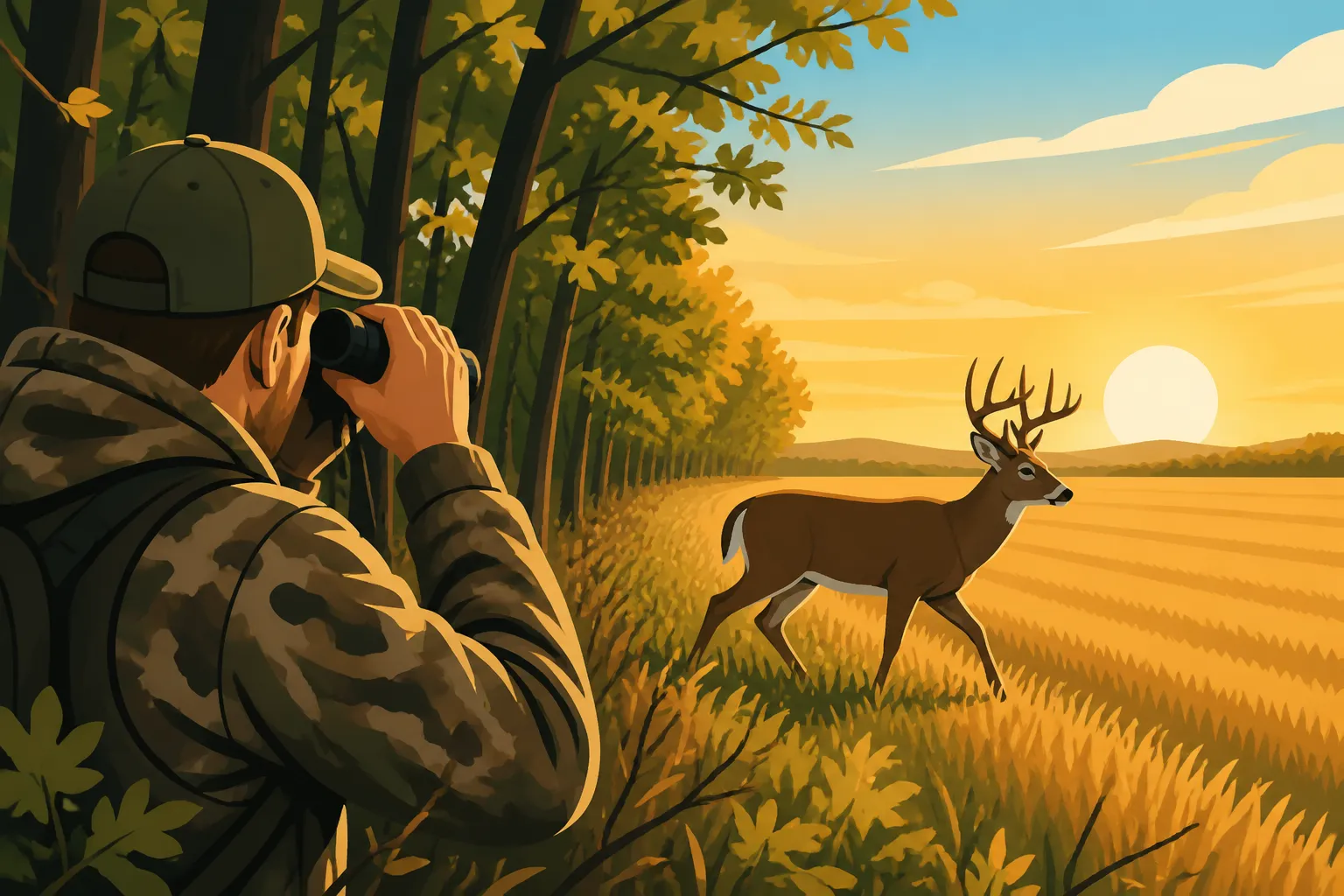
Once on the ground, your eyes are your most important tool, but knowing how to look is key. Don't just walk straight through the middle of a shelterbelt. Instead, walk its length, both along the field edge and perhaps a little deeper inside, zig-zagging to cover more ground. Pay particular attention to the intersections or corners of shelterbelts, as deer often pause and survey their surroundings here. You might find a cluster of rubs or a prominent scrape at a Hunting a Shelterbelt Corner at Dusk. Look for bottlenecks or pinch points where the cover narrows, or where a fence line forces deer to cross in a specific spot. Being quiet, moving slowly, and regularly pausing to look, listen, and scan will help you pick up on subtle signs you might otherwise miss. Remember, deer leave clues on both sides of the belt, not just the one facing the field.
Interpreting Pressure and Adaptation
Deer are incredibly adaptable creatures, and their behavior, and therefore the sign they leave behind, is heavily influenced by hunting pressure. On public lands or highly pressured private ground, deer using shelterbelts will often become largely nocturnal. They might feed in adjacent fields only under the cover of darkness, retreating to the thickest, most impenetrable parts of the shelterbelt during daylight hours. In such scenarios, fresh tracks leaving the shelterbelt late in the evening and returning early in the morning might be your only clue to their presence. Understanding Hunting Pressure on North Dakota Public Land is vital, as it often means adjusting your tactics from waiting on the field edge to still-hunting the cover itself.
Conversely, on less pressured ground, deer might be more active during daylight, using the shelterbelt as a secure travel route or even a midday bedding area. Interpreting the type and freshness of sign in relation to known pressure levels can help you predict deer movement more accurately. If you find heavy daytime sign (fresh rubs, active scrapes, fresh tracks) in a shelterbelt on a piece of public land that typically sees a lot of hunters, it might indicate a hidden gem that others have overlooked, or a particularly secure section of the belt.
Leveraging Shelterbelt Sign for Hunt Success
Finding deer sign is just the beginning. The real art is in translating that information into a successful hunt. Whether you prefer to sit patiently or actively pursue, shelterbelt sign provides the blueprint for your strategy.
Stand and Blind Placement Based on Sign
Once you've identified key deer activity zones within a shelterbelt—be it a heavily used trail, a series of fresh rubs, or an active scrape—your next step is strategic stand or blind placement. For archery hunting, you'll want to position yourself within bow range of these hot spots, often along the interior edge or a main trail within the belt. Consider the prevailing wind direction; deer have an incredible sense of smell, so always try to set up where your scent will blow away from their likely approach. If you're on the edge of the shelterbelt overlooking a field, a ground blind can be incredibly effective, especially if you take the time to brush it in well. A well-placed, camouflaged blind offers concealment and a comfortable setup, making Brushing In a Blind on a Field Edge critical for success.
For rifle season, your range is extended, but concealment and wind are still paramount. A climbing stand or ladder stand hung on one of the larger trees within the shelterbelt can offer an elevated vantage point, allowing you to see deer moving through the cover or emerging into the adjacent fields. If you're targeting a specific trail or a funnel point, make sure your stand offers a clear shooting lane. Consider how deer will approach the area and position yourself to intercept them without being detected. Mastering Hanging a Stand on a Shelterbelt Edge means not just picking a tree, but picking the right tree relative to the deer's likely path and the wind. Always have an exit strategy that allows you to leave your stand undetected.
Driving and Still-Hunting Shelterbelts
Shelterbelts, particularly longer or wider ones with dense cover, are excellent candidates for active hunting tactics like small deer drives or still-hunting. A small drive, involving just two or three hunters, can be incredibly effective at pushing bedded deer out of a shelterbelt towards waiting standers. One or two "pushers" walk slowly and loudly through the length of the belt, while others are positioned at the downwind end or along known escape routes. Communication is key, and safety paramount. For more detailed insights, you might look into Deer Drives With Three or Four Hunters. This tactic works well during late season when deer are seeking the thickest cover.
Still-hunting is another rewarding approach, especially for solo hunters or those who prefer a more stealthy, active method. This involves moving incredibly slowly and deliberately through the shelterbelt, taking a few steps, pausing for several minutes to glass and listen, and then repeating. Focus on moving into the wind, or with a crosswind, to keep your scent from blowing ahead of you. Pay close attention to any movement, flick of an ear, or flash of white tail. Still-hunting is particularly effective in the middle of the day, or during colder weather, when deer might be bedded tight in the thermal protection of the shelterbelt. It requires patience and a keen eye, but can lead to exciting, close-range encounters as you move through their living room.
Disclaimer
Hunting is an activity with inherent risks. Always prioritize safety, adhere to all local, state, and federal hunting regulations, and ensure you have the necessary licenses and permits. The information provided in this guide is for educational purposes and should not replace proper hunter education or professional guidance.