Rattling Volume on the Open Prairie
Rattling for deer on the open prairie of North Dakota can feel like shouting into a hurricane, or worse, whispering to a ghost. The vast, treeless expanses and the relentless prairie wind conspire to make a technique that's potent in timber seem completely futile here. Many hunters, myself included, have stood out there, clashing antlers together, only to wonder if any deer within a mile even heard a peep, let alone cared. This guide will dive deep into how to adjust your rattling volume and strategy to actually bring those prairie bucks into range, transforming what often feels like a shot in the dark into a calculated and effective tactic.
Understanding the Unique Challenges of Prairie Rattling
Before we even talk about how loud to rattle, we need to acknowledge why rattling on the prairie is so different. It's not just about the deer; it's about the environment itself, which plays by a completely different set of rules than a dense forest.
The Amplifying and Attenuating Effect of Open Spaces
One of the most profound challenges is the sheer scale of the prairie. In timber, sound bounces off trees, creating an echo and making it hard for an animal to pinpoint the exact source quickly. On the open prairie, sound travels much farther, but it also dissipates rapidly without anything to reflect it. This means that while a loud crash might carry for a long distance, it also loses its intensity and directionality. A buck a mile away might hear something, but it might not sound convincing enough to draw him in, or he might struggle to determine where it's coming from.
Moreover, the lack of visual obstructions means that if a buck does decide to investigate, he's likely to approach cautiously, using every bit of elevation or subtle cover available. He's not going to charge blindly through a clear-cut field. His eyes will be on high alert long before he gets close, scanning for the source of the sound and for any potential danger. This hyper-vigilance means your setup has to be impeccable, and your rattling sequence needs to be utterly convincing.
The Constant Variable of North Dakota Wind
Ah, the wind. If you've spent any time hunting North Dakota, you know the wind isn't just a factor; it's a relentless character in the story of every hunt. For rattling, it's both friend and foe. A strong wind can carry your sound miles downwind, potentially alerting bucks you'd never reach otherwise. But that same wind can completely obliterate your sound upwind, making your efforts useless. More subtly, the wind can make it incredibly difficult for a deer to discern the direction of your rattling. Sound waves get chopped up, carried, and distorted.
Think about standing on a blustery day and trying to hear a conversation happening a hundred yards away. It's almost impossible to make out words, let alone pinpoint precisely where the sound is coming from. Deer have exceptional hearing, but even they struggle against the constant roar and turbulence of a strong prairie breeze. This necessitates a strategic approach to wind direction, not just for scent control, but for sound propagation.
How Prairie Deer Respond to Aggression
Deer behavior on the prairie can also differ from their timber-dwelling cousins. While the core instincts are the same – fighting for does, establishing dominance – the tactics might be adapted to the open environment. A buck might be less inclined to blindly charge into an area where he could be silhouetted against the sky. Instead, he might circle downwind, using the wind to check for scent and the terrain to stay concealed as long as possible.
They're often more cautious, more prone to stopping at a distance to observe, and quicker to melt back into cover if they sense anything amiss. This means your rattling setup often needs to incorporate some element of visual appeal, like decoys, to seal the deal once the sound has done its job. Their natural wariness in open country dictates a more patient and nuanced approach to rattling than simply crashing antlers together.
Finding the Right Balance: Volume, Frequency, and Duration
So, given these challenges, how do you adjust your rattling? It boils down to a dynamic interplay of how loud you are, how often you rattle, and for how long. There's no single magic formula, as every situation will be a little different.
When to Go Loud: Making a Statement
There are definitely times on the prairie when you need to be LOUD. If the wind is whipping at 15-20 mph or more, or if you're trying to reach deer in distant coulees, draws, or shelterbelts a mile or two away, you absolutely have to crank up the volume. Think of it less as a subtle argument and more as a full-blown brawl. This means really crashing those antlers together, grinding them, and pushing hard to create maximum noise.
I've found that on these blustery days, a softer approach is simply swallowed by the wind. You need to create enough raw sound energy to cut through the ambient noise and carry across those vast distances. Don't be shy. The goal here is to pique curiosity at range, to get a buck to stop feeding or bedded, lift his head, and consider investigating. It's about getting his initial attention in an environment where sound easily disappears.
When to Scale Back: Subtle Invitations
Conversely, on calm mornings or evenings with little to no wind, or when you suspect deer are already relatively close (say, within a quarter to half-mile, tucked into a Hunting a North Dakota Prairie Pothole Slough Edge or a CRP field), a more subtle approach can be more effective. Here, you're not trying to blast sound across counties. You're trying to mimic a more realistic sparring match or a smaller, less aggressive encounter.
This might involve lighter clashes, more grinding, and less of the "hammering" sound you'd use in high wind. The goal is to sound convincing and local, rather than like a distant, ambiguous noise. If you go too loud when deer are close, you risk spooking them or making them suspicious. They might interpret overly aggressive rattling as a challenge too great to face, especially if they're a younger, less dominant buck. Sometimes, a gentle tickle of antlers, followed by soft grunts, is all it takes to convince an already curious buck to close the distance.
Varying Your Sequence: Mimicking a Real Fight
No two deer fights are identical, and your rattling sequence shouldn't be either. A real fight starts, pauses, intensifies, and then winds down. Mimic this. Don't just clash for 30 seconds straight and stop. Start with a few light taps, then build into some aggressive crashing and grinding for 15-30 seconds. Imagine two bucks circling, testing each other, then locking up. Include periods of silence, maybe 1-2 minutes, where you're listening intently and scanning with your binoculars. Then, repeat, perhaps with a different intensity.
Adding vocalizations, like aggressive grunts or snort-wheezes, can be incredibly effective. Even if you're not using a grunt tube every time, incorporate the idea of vocalizations into your "story." This layered approach makes your sequence sound far more authentic than just a repetitive clatter of antlers. During the pause, remember that a buck approaching from a distance will often stop to listen and look. That's your chance to glass, ideally with powerful optics, and spot him before he spots you.
Duration: Patience is a Virtue
How long should you rattle? This is where many hunters make a mistake, either giving up too soon or rattling too much. For an aggressive, loud sequence, 15-30 seconds of active rattling followed by 1-3 minutes of intense scanning and listening is a good starting point. Repeat this 3-4 times over a 10-15 minute period in one location. Then, consider moving a few hundred yards to a new spot if nothing responds.
Prairie bucks, especially bigger ones, are often highly cautious. They won't always come flying in. They might take 5, 10, even 20 minutes to show themselves, often circling downwind to catch your scent. So, don't pack up after five minutes. Give the area time to "settle," and give any interested buck time to commit. This patient approach is crucial for Rattling and Decoying Prairie Pothole Bucks. Remember, you're trying to draw an animal that might be a long way off, and even if he's interested, he's going to take his sweet time getting there.
Adapting Your Rattling Strategy to Wind and Terrain
The prairie is defined by its wind and its subtle, yet significant, terrain features. Ignoring these when rattling is like trying to hunt with one eye closed.
Using Wind to Your Advantage
Instead of battling the wind, learn to work with it. The general rule of thumb for any scent-aware hunting technique is to keep the wind in your face. For rattling, it's a bit more nuanced. You want your sound to carry downwind into areas where bucks might be bedded or feeding, but you still want your scent to be blowing away from where you expect deer to approach. This often means positioning yourself so your sound travels across the wind or slightly downwind, while your actual body odor is carried away on a crosswind.
For instance, if the wind is from the west, and you're rattling east, your sound will be muffled. But if you're rattling north or south, your sound will carry with the crosswind. If you can get just a slight rise, or the edge of a Hunting a Shelterbelt Edge for Deer or a field of Hunting Standing Sunflowers for Deer and Geese at your back, it can help push the sound out more effectively, and potentially funnel it in a particular direction. Always assume a buck will try to circle downwind of the sound source, so set up with that in mind, creating a shooting lane for that approach, or even placing a decoy to draw his attention to that spot.
Leveraging Subtle Terrain Features for Amplification
The prairie isn't flat, even if it often looks that way. It's full of subtle draws, coulees, CRP edges, and river bottoms. These features are your best friends when rattling.
- Draws and Coulees: Rattling from the top of a draw, letting the sound echo down into it, can be incredibly effective. Bucks often bed in these protected areas, and the sound can reverberate, making it sound closer and more intense. Always scout these areas beforehand, perhaps using a tool like the GoHunt app or Reading Aerial Photos for Badlands Deer, to know where the deer typically travel within them.
- CRP Edges and Field Borders: The dense cover of CRP (Conservation Reserve Program) grass offers excellent bedding areas. Rattling from the edge, especially with the wind carrying the sound into the CRP, can draw bucks out. Similarly, the edge of a standing cornfield or a shelterbelt provides both cover for you and an edge where deer feel comfortable moving.
- River Bottoms: Along the Missouri River corridor or other river systems, the timbered bottoms and bluffs provide more traditional rattling cover. Here, the challenge shifts slightly, but the principles of varying volume and using the wind remain crucial. Knowing how to predict deer movement in these areas, perhaps by Reading a Missouri River Bottom for Deer, will enhance your rattling success.
Practical Tips and Gear for Effective Prairie Rattling
Beyond technique, having the right tools and mindset can make a significant difference in your prairie rattling success.
Rattling Antlers Versus Bags
When it comes to rattling, you have a couple of options.
- Real Antlers: Nothing truly replicates the sound of real antlers crashing together. They offer the most authentic sound, from light ticks to heavy crashes and grinds. For the prairie, where you often need to generate significant volume, real antlers are usually the superior choice. Look for shed antlers that are thick and robust, offering a good base for sound. Brands like Primos or Knight & Hale offer good sets specifically designed for realistic combat sounds. The downside is they can be bulky and noisy to carry if not properly secured.
- Rattling Bags/Faux Antlers: These are more compact and quieter to carry, but often struggle to generate the sheer volume needed for truly open country. While they might work well in light wind or close quarters, they often fall short when you need to project sound for hundreds of yards against a stiff breeze. However, some newer designs, like those from Black Rack, are getting much better at mimicking the authentic sound.
Decoys: The Visual Closer
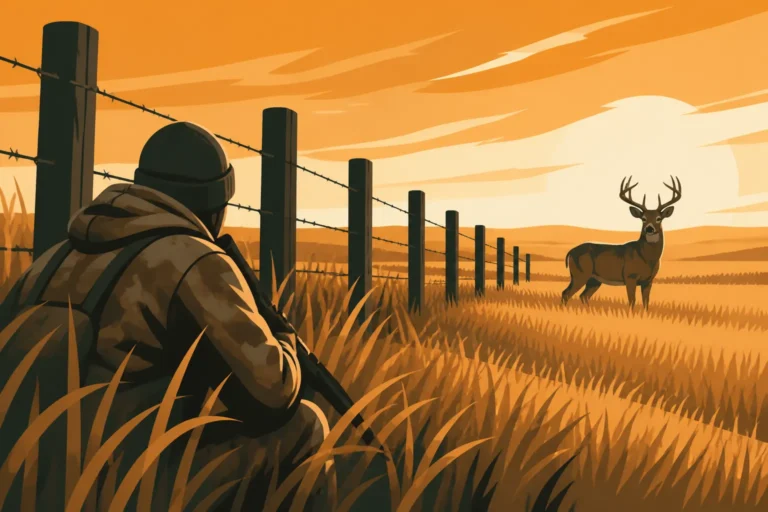
On the open prairie, a buck responding to your rattling will often approach cautiously, trying to visually locate the source of the sound. If all he sees is a lone hunter, he's likely to hang up out of range or circle for scent and bust you. This is where a decoy becomes invaluable. A good quality deer decoy, especially a lightweight, packable model like those from Montana Decoy, can act as a visual magnet.
- Positioning: Set up your decoy slightly downwind of your rattling position, facing generally towards where you expect deer to approach. This gives the approaching buck something to focus on, drawing his attention away from you.
- Types: A dominant buck decoy or even a doe decoy can be effective. A buck decoy might challenge a dominant buck or draw in a younger buck looking for a fight. A doe decoy can lure in a buck looking to breed.
- Concealment: Ensure you are well-hidden, ideally in a ground blind or natural cover like a small brush pile or a cut bank. Using a Ground Blind on PLOTS Land can provide crucial concealment when Hunting a North Dakota Prairie Pothole Slough Edge or other open areas.
Observation Tools: Eyes on the Prize
Given the vastness of the prairie, good optics are not just helpful; they are absolutely essential. When you finish a rattling sequence, immediately get your binoculars up and scan every inch of the surrounding landscape, especially downwind and in any draws or rises. Bucks will often appear as if from nowhere, pausing to look before moving closer.
A quality pair of 10×42 binoculars (or even 12×50 for really wide-open country) can mean the difference between spotting an incoming buck at 800 yards and having him appear at 150 yards, already on high alert. Utilizing scouting platforms like GoHunt or similar apps can help you understand the terrain nuances beforehand, giving you a better idea of where deer might emerge from. You can learn a lot from Spotting Pronghorn From a Section Road about how to scan open country effectively for any movement.
The Best Time to Rattle
While rattling can work at various times during the deer season, it's most effective during the rut, when bucks are actively seeking does and are more prone to fighting. In North Dakota, the rut typically peaks in early-to-mid November. This is when buck testosterone levels are highest, and they are most willing to respond to the sound of a fight. Knowing When the North Dakota Rut Peaks is critical for maximizing your rattling efforts. Don't be afraid to try it during the pre-rut as well, when bucks are establishing dominance. Even during the late season, a lone buck might be convinced to come in, especially if he's heard a fight and is looking for a last chance at a hot doe.
Remember to consider other factors like North Dakota Public Land Hunting Hours and ensure you're always operating within legal daylight hours. Scouting during the off-season, identifying travel corridors, and knowing the habits of the local deer herd can also dramatically improve your success rate. Pay attention to signs like Reading North Dakota Mud for Fresh Deer Movement to gauge current activity.
Staying Patient and Flexible
Ultimately, rattling on the open prairie demands patience and flexibility. The wind will change, deer might be in different areas, and what worked yesterday might not work today. Don't get discouraged if you don't call in a buck on your first few attempts. Keep experimenting with your volume, frequency, and duration. Adjust your setup based on the wind and the subtle terrain features. Most importantly, stay vigilant. That buck might just appear when you least expect it, making all those seemingly futile efforts worthwhile.
Rattling Volume on the Prairie: A Quick Guide
| Situation | Wind Speed | Recommended Volume | Frequency | Duration | Key Considerations |
|---|---|---|---|---|---|
| Distant Deer / High Wind | 15+ mph | LOUD | Aggressive, varied | 15-30 sec burst, 1-2 min pause, repeat 3-4 times over 15-20 min | Cut through wind, project sound, use real antlers. |
| Mid-Range / Moderate Wind | 5-15 mph | Moderate to Loud | Varied | 10-20 sec burst, 1-2 min pause, repeat 2-3 times over 10-15 min | Balance projection with realism. Use wind to carry sound. |
| Close Range / Calm Wind | 0-5 mph | Subtle to Moderate | Realistic, soft | 5-15 sec burst, 30 sec – 1 min pause, repeat 2-3 times over 10 min | Mimic sparring, avoid spooking. Use soft grunts. |
| Deer Response (Hang-up) | Any, but often calm | Very Subtle, Grunts | Infrequent | Short (5-10 sec), then silent | Only enough to draw them closer, don't overdo it. |
Disclaimer
Hunting is an activity that carries inherent risks. Always prioritize safety, adhere to all local, state, and federal hunting regulations, and obtain proper licenses and permits before engaging in any hunting activities. The information provided in this guide is for informational purposes only and should not be taken as legal advice or a substitute for proper hunter education and experience. Always be aware of your surroundings, your target, and beyond.