North Dakota Whitetail Color Phase Rarities
Have you ever been out hunting in North Dakota, seen a flash of white, or an unusually dark deer, and had it stop you dead in your tracks? It sparks a mix of awe and wonder, leaving you questioning what you just saw. These aren't just regular deer with strange lighting; they're rare color phase whitetails, and this guide will dive deep into what makes them unique and what encountering one truly means for us hunters on the prairie.
Understanding Normal Whitetail Coat Colors in North Dakota
Before we dive into the truly unusual, it's helpful to establish a baseline for what "normal" whitetail coloration looks like here in North Dakota. Our deer are creatures of adaptation, and their typical coats serve a vital purpose: camouflage. They blend seamlessly into the diverse landscapes, from the Missouri River bottomlands to the Badlands draws and the endless prairie.
The Classic Brown and Gray Pattern
Most of the whitetail deer you'll encounter in North Dakota sport a coat that shifts with the seasons. In the warmer months, typically from late spring through summer, their pelage takes on a reddish-brown hue. This lighter, often more vibrant color helps them disappear into the greening alfalfa fields, maturing corn, and lush timber. It's a coat designed for active days in the sun, reflecting some of that intense prairie heat.
As autumn progresses and the crisp North Dakota air settles in, that reddish-brown gives way to a much thicker, grayer, and often shaggier coat. This winter camouflage is perfectly suited for the muted tones of late-season fields, barren shelterbelts, and snow-dusted coulees. The grayer tones break up their outline against the grays and browns of dormant vegetation, while the thicker hair provides crucial insulation against our notoriously brutal winters. You might notice slight variations even within this standard pattern, with some deer appearing a bit darker or lighter depending on their specific diet and the local mineral content in their range, but the overall brown-to-gray transition is the norm.
The Role of Genetics in Standard Coloration
The reason we see this consistent pattern across the vast majority of our whitetail herd is rooted in genetics. Deer, like all mammals, have genes that dictate the production and distribution of melanin, the pigment responsible for hair and skin color. In whitetails, the genes for these common brown and gray colorations are largely dominant, meaning they are the ones most frequently expressed.
Think of it like a family trait that's passed down consistently. While there might be minor individual differences, the strong genetic predisposition ensures that the vast majority of fawns are born with spotted, reddish-brown coats that mature into the standard adult colors. These dominant genes are highly successful because they produce offspring that are well-camouflaged and adapted to their environment, giving them the best chance for survival against predators and the elements. Any deviation from this pattern usually involves a rare genetic twist, which is where the truly fascinating color phases come into play.
The Alluring World of Whitetail Color Phase Rarities
While the vast majority of North Dakota's whitetail population sports the classic brown-and-gray, every now and then, nature throws us a truly unique curveball. These are the rare color phase deer—animals whose genetics have produced a coat strikingly different from the norm. Encountering one in the field is a truly special moment, often leaving hunters buzzing for days.
Piebald Deer: The Most Recognizable Anomaly
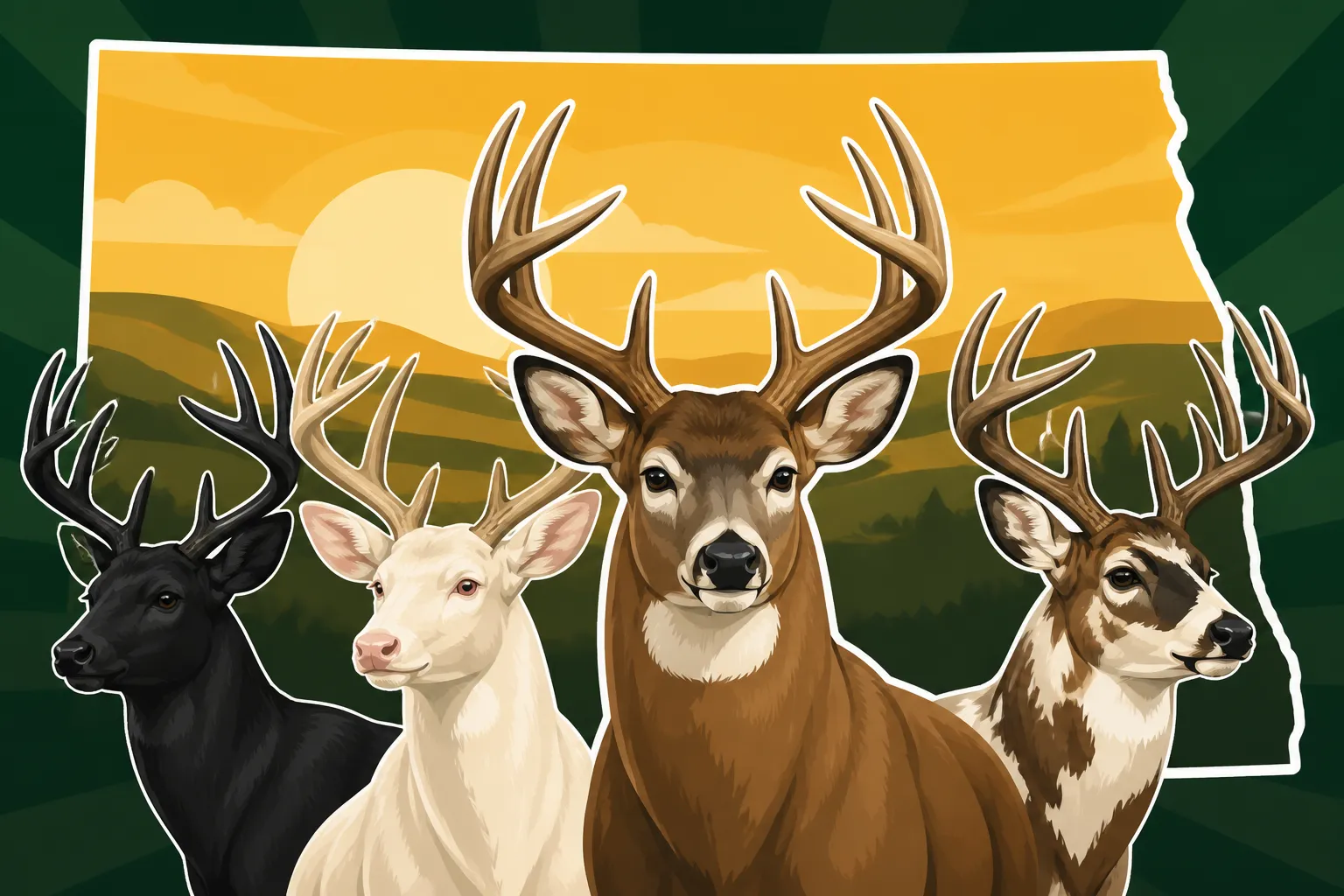
Perhaps the most commonly recognized of the rare color phases is the piebald deer. These aren't just deer with a little white on their chest; piebalds are characterized by irregular patches of white hair mixed with their normal brown or gray coat. The white patches can be small and scattered, or they can cover significant portions of the body, sometimes making the deer appear mostly white.
What's really interesting about piebalds is that their unique coloration isn't just skin deep. The genetic mutation responsible for piebaldism, a recessive gene, often comes with other physical characteristics. You might notice they have shorter legs, a Roman nose, or an arched spine, sometimes even slightly bowed legs. Their hooves can also be lighter in color. While these animals are captivating to see, these physical anomalies can sometimes put them at a disadvantage in the wild, affecting their agility or overall health. Despite this, many hunters feel a surge of excitement and respect when they spot a piebald, viewing them as a unique trophy of observation, even if not harvested. Keeping a keen eye on the ground for Reading North Dakota Mud for Fresh Deer Movement might just give you a hint that one of these unique animals is in the area.
Albino Deer: A True Lack of Pigmentation
Even rarer than piebalds are true albino deer. When you see an albino, there's no mistaking it: the animal is entirely white, from head to tail. Unlike piebalds, albinos lack all melanin, the pigment responsible for color in hair, skin, and eyes. This complete absence of pigment gives them their distinctive features.
A true albino will have a pure white coat, but the most telling sign is their eyes, which appear pink or reddish due to the blood vessels showing through the unpigmented iris. Their nose and hooves will also be pink. This lack of pigmentation is due to a completely recessive genetic trait, making it incredibly rare for a fawn to inherit two copies of this gene. Unfortunately, being truly albino comes with significant challenges. Their pure white coats make them stand out starkly against most natural backgrounds, severely compromising their camouflage. This makes them more vulnerable to predators. Additionally, their eyes are often more sensitive to sunlight, sometimes leading to vision problems that can hinder their ability to navigate and find food. Seeing a true albino is a once-in-a-lifetime experience for most hunters, a stark and beautiful reminder of genetic diversity.
Melanistic Deer: The Seldom-Seen Dark Phase
While most people think of white deer as rare, the opposite extreme—melanistic deer—are arguably even more uncommon, especially in North Dakota. Melanistic deer are characterized by an exceptionally dark, often almost black, coat. This deep coloration is due to an overproduction of melanin, the exact opposite of what happens with albinism.
Encountering a melanistic whitetail is incredibly rare, so much so that many hunters spend their entire lives in the woods without ever seeing one. Their dark color can be so profound that the typical whitetail markings, like the white throat patch or the characteristic white underside of the tail, might be obscured or appear much duller. These deer blend in extremely well in deeply shaded, dense timber environments, making them even harder to spot. While they are more commonly reported in certain southern states with high humidity and thick cover, a melanistic whitetail in North Dakota would be an extraordinary sighting, truly a marvel of natural variation.
Other Less Common Variations: Reddish or Creamy Hues
Beyond the well-known piebald, albino, and melanistic forms, you might occasionally encounter other, more subtle variations in whitetail coloration that still stand out from the typical. These aren't usually tied to a specific, defined genetic mutation like albinism, but rather to a unique combination of genes that results in slightly different pigment expressions.
For instance, some deer might exhibit an unusually strong reddish hue in their winter coat, making them appear almost rusty against the snowy landscape. Others might have a creamy, almost golden blonde coloration that, while not pure white, is distinctly lighter than the standard grayish-brown. These variations can sometimes be influenced by factors like age, diet, or even the deer's overall health, but they are still striking enough to catch a hunter's eye. While a dedicated mapping and scouting platform like GoHunt is primarily used for finding good hunting spots and understanding terrain, it can also be a fantastic resource within its community features where hunters share photos and observations of these kinds of unique animals, helping others appreciate the spectrum of whitetail beauty.
Here's a quick overview of these fascinating color phases:
| Color Phase | Appearance | Genetic Cause | Rarity in Whitetails (North Dakota) | Survival Impact (General) |
|---|---|---|---|---|
| Normal | Reddish-brown (summer), Grayish-brown (winter) | Dominant melanin genes | Common | Well-camouflaged, adapted |
| Piebald | Irregular white patches on normal coat | Recessive gene for partial pigmentation lack | Rare but recognizable | Can have physical anomalies, reduced agility |
| Albino | Pure white coat, pink eyes, pink nose/hooves | Recessive gene for complete melanin lack | Extremely Rare | Poor camouflage, vision issues |
| Melanistic | Exceptionally dark to black coat | Excess melanin production (dominant gene) | Extremely Rare | Can improve camouflage in dark habitats |
| Erythristic | Abnormal reddish or blonde coat | Recessive gene for red pigment only (rare) | Very Rare | Varies, often less camouflaged |
Note: Erythristic, sometimes called "red phase," is another specific genetic variation causing a reddish or blonde coat due to the absence of dark pigments. While not as widely discussed as piebald or albino, it's another true rarity.
Why These Color Phases Matter to Hunters
Beyond the sheer wonder of seeing something so rare, encountering a color phase whitetail often brings up a whole host of questions and considerations for hunters. These unique animals aren't just biological curiosities; they represent a crossroads of ethics, wildlife management, and the deep appreciation we have for the natural world.
Ethical Considerations and Hunting Decisions
For many hunters, the sight of a piebald or albino deer immediately sparks an internal debate. Should such a unique animal be harvested? There's no single right answer, and it often comes down to personal ethics and the specific circumstances. Some hunters feel a strong inclination to let these animals walk, viewing them as too special or rare to take. They might believe that these deer, due to their distinct appearance, deserve to live out their lives as living emblems of nature's diversity. Others might argue that a deer is a deer, regardless of its coat color, and if it's legal and within their hunting plan, it's fair game.
The decision is yours alone, but it's a conversation that highlights the respect we have for wildlife. While a single piebald or albino typically has a minimal genetic impact on the overall herd, given their rarity and often reduced survival rates, the emotional impact of encountering one is profound. It forces us to pause and consider the beauty and uniqueness in nature. When considering your approach to hunting an area, being mindful of potential rare sightings is another layer to the challenge of dealing with Hunting Pressure on North Dakota Public Land, as more eyes in the woods might lead to more sightings, and more ethical considerations.
Management and Observation in North Dakota
From a wildlife management perspective, state agencies like the North Dakota Game and Fish Department generally do not classify piebald or albino whitetails as protected species. They are typically considered part of the regular whitetail population and fall under the standard hunting regulations for deer. This means that if you have a valid tag for the unit you're hunting, and the deer meets all other legal criteria (e.g., antler restrictions if any), harvesting a color phase whitetail is usually permissible.
However, many biologists and wildlife enthusiasts appreciate being informed of sightings or harvests of these rare animals. Such data, even anecdotal, can contribute to a broader understanding of genetic variations within local deer populations. Platforms like GoHunt, with their extensive mapping tools and community features, aren't just for finding the best North Dakota Deer Harvest Records for a particular unit; they can also be used as a place to share observations with fellow hunters, fostering a collective appreciation for these natural wonders. Reporting a sighting to Game and Fish, even if just informally, helps build a picture of where these rare genetics might be present in our state. By keeping track of things like North Dakota Buck-to-Doe Ratio by Region, wildlife managers can get a picture of herd health, but unique genetic expressions like color phases add another layer of biological interest.
Practical Tips for Spotting and Appreciating Rare Whitetail Colors
Encountering a rare color phase whitetail is often a matter of luck, but you can certainly increase your odds and enhance the experience with a few practical approaches. It's about being observant, patient, and leveraging the tools available to us as modern hunters and outdoors enthusiasts.
Patience and Observation Skills
The most crucial ingredient in spotting a rare color phase deer is simply time spent in the field, coupled with an acute sense of observation. These animals are, by definition, rare, so you won't find one every time you step out. Focus on patiently watching areas where deer activity is high, such as along a shelterbelt edge at dusk or near known food sources.
When you're glassing a field or scanning a timberline, don't just look for "a deer." Train your eyes to notice anomalies in color or pattern. A flash of white in an unexpected place, or a deer that seems unusually dark against its surroundings, should immediately grab your attention. High-quality binoculars and spotting scopes are invaluable tools for this, allowing you to thoroughly scrutinize distant animals before they disappear. Many hunters spend countless hours scouting specific spots, such as identifying Entry Routes Through Standing Sunflowers or understanding movement patterns in Hunting Standing Corn for Late-Season Geese. It's in these moments of careful observation that unique sightings often occur.
Utilizing Technology and Community Resources
In today's hunting world, technology offers fantastic opportunities to not only scout but also document and share rare wildlife encounters. Trail cameras are an excellent way to capture images of deer that might be utilizing a specific area, often catching animals you'd never see with your own eyes. If you're consistently getting photos of an unusually colored deer, you know you've found something special.
Beyond your own personal scouting efforts, the broader hunting community can be a wonderful resource. Online forums, social media groups, and even platforms like GoHunt often have dedicated sections where hunters share photos and stories of unique wildlife sightings. Engaging with these communities can provide insights into specific regions where rare color phases have been observed, giving you a better idea of where to concentrate your efforts. While GoHunt is exceptional for its detailed maps and scouting tools, showing everything from terrain features to public land boundaries, its user base and community engagement can also serve as a collective eye on the landscape, helping to track and appreciate these stunning anomalies across North Dakota. This collaborative approach not only aids in observation but also fosters a shared respect for the wild wonders we are privileged to witness.
Disclaimer
This article is for general informational purposes only and does not constitute professional advice. Laws, prices and regulations vary by location and change over time. Consult a qualified professional for guidance on your specific situation.