Best Public Ground for Badlands Mule Deer
Finding good public ground for mule deer in North Dakota's rugged Badlands can feel like searching for a needle in a thousand haystacks. It’s an intimidating landscape, vast and unforgiving, and knowing where to start your hunt for a trophy buck without wasting precious time and energy is a common frustration. This guide will help you pinpoint the best public hunting areas in the North Dakota Badlands for mule deer, offering insights into their habitat and practical strategies for a successful hunt.
Understanding Badlands Mule Deer Habitat on Public Land
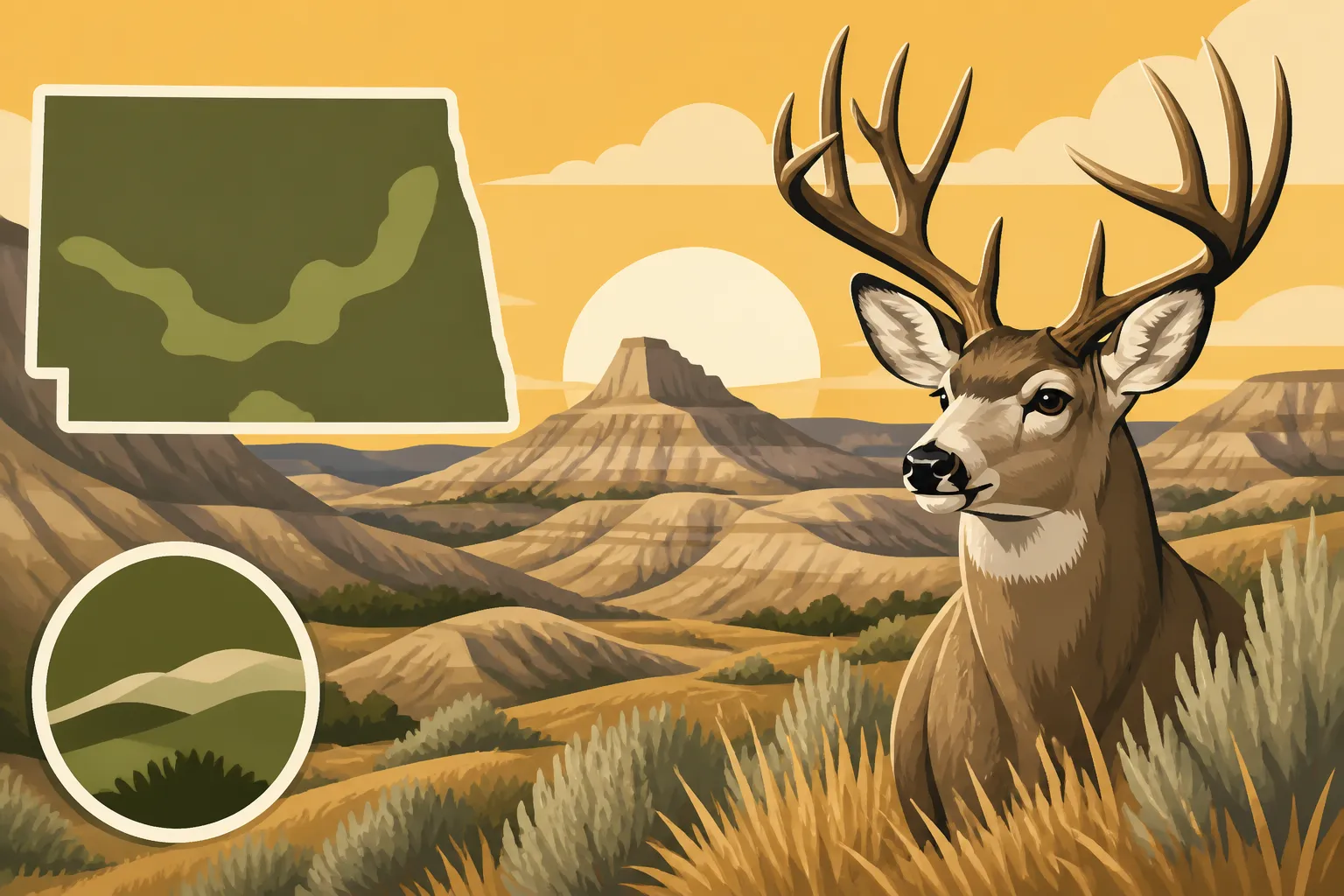
The North Dakota Badlands are a truly unique ecosystem, a stark contrast to the rolling prairies that dominate much of the state. Carved by centuries of erosion, this region of western North Dakota presents a dramatic tableau of buttes, coulees, draws, and rugged plateaus. It's an unforgiving landscape for humans, but it's precisely this wild, broken country that mule deer call home. Understanding their preferences within this complex terrain is the first step to finding them on public land.
The Allure and Challenge of Badlands Mule Deer
The allure of hunting mule deer in the Badlands is undeniable. These animals are incredibly adapted to their environment, displaying a hardiness and wariness that makes pursuing them a true challenge. Unlike their whitetail cousins, mule deer often prefer open, broken country where they can use their keen eyesight and incredible bounding gait to escape danger. Spotting a big muley buck against the backdrop of a shale slope or silhouetted on a ridge line is a sight every hunter dreams of. The sheer scale of the Badlands, however, also presents its greatest challenge. Miles of similar-looking terrain can disorient even experienced hunters, and finding concentrations of deer rather than just random individuals requires a deep understanding of their habits. The sparse cover means that once a deer spots you, they're often gone in a flash, demanding stealth and patience.
The weather here can be another significant hurdle, swinging wildly from scorching hot days to sudden, fierce blizzards, even during hunting season. Hunters need to be prepared for anything, carrying ample water, proper navigation tools, and layers of clothing. Wind and Thermals in Badlands Terrain are critical factors to consider, as they dictate not only your scent cone but also how deer will move and bed throughout the day. It's a physically demanding hunt, often requiring long hikes up and down steep grades, crossing washes, and navigating dense pockets of juniper and brush.
Key Habitat Features to Look For
Mule deer in the Badlands aren't just anywhere; they favor specific types of terrain that offer food, water, and most importantly, security. When you're scouting, whether from afar with maps or with boots on the ground, you need to be looking for these critical habitat components. Deep, winding coulees and draws are absolute magnets. These natural creases in the earth provide shelter from the wind, shade from the sun, and often hold more moisture, leading to better forage. They act as natural travel corridors and bedding areas, especially on north-facing slopes which tend to retain more snow and provide cooler bedding sites into the fall.
Juniper patches, often found clinging to these slopes or dotting the plateaus, are another crucial element. These dense, often impenetrable thickets offer thermal cover in winter and excellent hiding spots year-round. A big muley buck knows he can disappear into a juniper patch and be virtually invisible. Look for these darker green patches on aerial maps. Water sources, though scarce, are also key. Small springs, seeps, or even temporary pockets of water after a rain can draw deer in. Even if you don't find standing water, look for drainages that lead to potential water sources outside the immediate public land boundary, as deer may travel to and from these areas. Finally, the edges of agricultural fields bordering the Badlands, particularly those with standing corn or sunflowers, can be crucial food sources, especially in the late season.
Prime Public Hunting Areas for Mule Deer in the Badlands
When you talk about public land mule deer hunting in the North Dakota Badlands, one name immediately comes to mind due to its sheer scale and reputation. However, smart hunters know there are other, often overlooked, parcels that can produce just as well, if not better, if you're willing to do your homework. These areas offer different challenges and rewards, catering to various hunting styles and preferences.
Little Missouri National Grassland: The Expansive Opportunity
The vast Hunting North Dakota's Little Missouri National Grassland is arguably the crown jewel for public land mule deer hunting in North Dakota. Spanning over a million acres across multiple counties in western North Dakota, it offers an incredible amount of contiguous habitat. The sheer size means that even during the busiest hunting seasons, you can find solitude and unpressured deer if you're willing to walk. This grassland is characterized by its dramatic badlands topography, featuring a mosaic of prairie, sagebrush flats, steep breaks, and timbered draws primarily dominated by juniper and ponderosa pine.
Mule deer thrive in this varied environment. The deep, broken terrain provides endless bedding and escape cover, while the interspersed grasslands offer critical foraging opportunities. Units that fall primarily within the Little Missouri National Grassland, especially in counties like McKenzie, Billings, and Golden Valley, are often considered prime locations. Focus your scouting efforts on areas far from established roads and trailheads. These remote pockets, often requiring a good hike or horseback ride, are where the mature bucks tend to hold up. Utilize tools like onX Hunt or GoHunt to navigate this expansive landscape, identify land boundaries, and pinpoint remote access points. Looking at How Many Mule Deer Live in the Badlands reveals that these grasslands are their stronghold.
State School Lands and Other Scattered Public Parcels
Beyond the expansive national grasslands, North Dakota has a significant amount of State School Land interspersed throughout the Badlands. These are smaller, often square-mile sections (640 acres) that were granted to the state to support public education. They are publicly accessible for hunting unless specifically posted otherwise, which is rare. The beauty of these school lands is that they are often overlooked by hunters who focus solely on the larger national forest blocks, meaning they can hold surprisingly unpressured deer, including mature bucks.
You'll find these parcels peppered across the landscape, sometimes surrounded by private land. It's crucial to use a robust mapping application like onX Hunt to identify these sections and verify their public access status. Finding North Dakota Property Lines is essential here. Look for school sections that are adjacent to or connect to other public lands, or those that contain significant draws, juniper patches, or natural funnels. While each section is relatively small, stringing a few together or using them as access points to larger private land parcels (with permission) can create fantastic hunting opportunities. Additionally, don't forget about smaller, less-known Wildlife Management Areas (WMAs) or federal Waterfowl Production Areas (WPAs) that might have suitable deer habitat, particularly those on the fringes of the Badlands ecosystem.
Strategies for Locating Mule Deer on Public Badlands Ground
Finding mule deer in the vastness of the Badlands requires a strategic approach. You can't just drive around hoping to stumble upon them; these animals are too cunning and the terrain too complex. Modern technology, combined with traditional hunting skills, forms the most effective strategy for pinpointing where those big bucks are hiding. It’s all about maximizing your time and effort in a landscape that demands both.
E-Scouting Before You Go
Before you even tie your boots, dedicating significant time to e-scouting from home is paramount. This initial research allows you to cover hundreds of square miles virtually, identifying promising areas without expending physical energy. Start by studying detailed satellite imagery and topographic maps using platforms like onX Hunt or GoHunt. These tools are invaluable for Reading Aerial Photos for Badlands Deer and understanding the topography, which is the ultimate key to success. Look for the deepest, most complex drainages, particularly those with north-facing slopes that offer cooler bedding. Identify dark green patches that indicate juniper cover – these are prime bedding areas Where Badlands Bucks Bed.
Pay close attention to pinch points, natural funnels created by the terrain, and areas where multiple draws converge. These are common travel routes for deer. Also, mark any potential water sources, even small seeps, as deer will often be found within a reasonable distance of water. Look for hidden pockets of cover that are difficult to access, perhaps surrounded by steeper terrain or requiring a longer walk; these are often where the biggest bucks seek refuge from hunting pressure. Cross-reference your identified public land boundaries with these features to ensure you're within accessible hunting zones.
Boots-on-the-Ground Scouting and Glassing Techniques
While e-scouting can narrow down your search, nothing replaces boots-on-the-ground scouting. Once you've identified promising areas on your maps, it's time to hit the field, ideally before the season opens, if possible. The Badlands are truly a glassing country. Forget still-hunting through thick timber; here, your optics are your most valuable tool. A good pair of binoculars (10x or 12x) and a high-quality spotting scope are essential. Find a high vantage point – the top of a butte or a prominent ridge – and methodically pick apart the opposite slopes and draws. Take your time, sometimes spending hours in one spot.
Start glassing from the bottom of the draws and slowly work your way up, paying close attention to shadows, juniper patches, and any anomalies that look like a deer. Often, you'll only see a small part of a deer, like an ear, a patch of hide, or an antler tip. Early morning and late evening are prime times, as deer will be moving from bedding to feeding areas. During midday, focus on shaded bedding areas in those deep coulees or dense juniper pockets. When you spot a deer, resist the urge to immediately move. Observe its behavior, learn its travel patterns, and plan your stalk carefully. Glassing for Moose in River Bottom Willows is a similar concept, just applied to a different species and habitat type, emphasizing the importance of patience and detailed observation.
Navigating Access and Pressure on Badlands Public Land
The very remoteness and vastness that make the Badlands so appealing for mule deer hunting can also make access a challenge. Knowing how to get to these prime areas and understanding how other hunters might impact deer behavior is crucial for a successful trip. It's not just about finding the deer; it's about finding them without bumping them due to human activity or getting lost yourself.
Understanding Access Points and Vehicle Rules
Accessing public land in the Badlands often involves a mix of paved roads, gravel roads, and sometimes two-track trails or fire breaks. Many prime areas within the Little Missouri National Grassland, for instance, are bisected by county roads, but the best hunting usually lies far off these main arteries. It's critical to know Vehicle Rules on North Dakota Public Land before you go. Generally, motorized vehicles are restricted to designated roads and trails, and cross-country travel is prohibited. This means you'll often have to park and hike in, sometimes for miles, to reach unpressured areas.
Your e-scouting should include identifying legal parking areas and potential walk-in access points. Look for section lines or designated access routes. Be mindful of private property that might border public land; always respect "No Trespassing" signs and ensure you are on legal public access. Sometimes, even a well-placed section of State School Land can serve as a valuable walk-through corridor to larger public tracts. Plan your entry and exit routes carefully, especially if you anticipate packing out a deer. The Badlands terrain can be incredibly deceptive and grueling, and a several-mile pack-out can take hours.
Dealing with Hunting Pressure and Finding Seclusion
North Dakota's Badlands, while vast, can still experience significant hunting pressure, particularly during the firearm season or on easily accessible public lands. Mule deer are incredibly sensitive to human activity, and heavy pressure will quickly push them into the deepest, most remote, and thickest cover available. The key to success is to find areas that other hunters overlook or are unwilling to venture into. This often means walking farther than most people.
Target areas that are at least a mile or two from the nearest road or popular trailhead. Even a half-mile walk can significantly reduce the number of encounters with other hunters. Look for natural barriers like steep draws, deep washes, or dense juniper that might deter less determined hunters. Hunting mid-week can also offer a significant advantage over busy weekends. If you're hunting during an archery season, consider the Hunting North Dakota's Nine-and-a-Half-Day Bow Restriction as a factor in nonresident pressure. During rifle season, deer may be pushed into thicker coulees or patches of timber they wouldn't normally frequent. The harder you work to get into these secluded spots, the greater your chances of finding an unpressured mule deer buck.
Public Land Types for Badlands Mule Deer
Understanding the different types of public land available in the Badlands can help you strategize your hunt more effectively. Each type offers distinct characteristics, access rules, and potential for finding mule deer.
| Public Land Type | Primary Characteristics | Mule Deer Potential | Access Considerations | Hunting Pressure |
|---|---|---|---|---|
| Little Missouri National Grassland | Vast, contiguous, broken badlands, juniper, prairie | High; holds core mule deer populations, mature bucks | Generally good, but remote areas require long walks | Moderate to High, depends on proximity to roads |
| State School Lands | Scattered 640-acre sections, interspersed with private land | Can be excellent; often overlooked, holding unpressured deer | Must confirm boundaries; walk-in often required | Low to Moderate |
| Wildlife Management Areas (WMAs) | Managed for wildlife, varied habitat, some Badlands fringe | Good; managed habitat can attract deer | Designated parking, specific WMA rules apply | Moderate |
| Waterfowl Production Areas (WPAs) | Smaller, wetland-focused, some uplands on Badlands fringe | Limited directly for mule deer, but can offer travel corridors | Primarily walk-in, specific WPA rules | Low |
Disclaimer
This article is for general informational purposes only and does not constitute professional advice. Laws, prices and regulations vary by location and change over time. Consult a qualified professional for guidance on your specific situation.