Spot-and-Stalk Elk in the Little Missouri Badlands
Hunting elk in the rugged, expansive terrain of North Dakota's Little Missouri Badlands is an incredible challenge that tests even the most seasoned hunters. Many folks, myself included, have spent countless hours glassing endless coulees only to be foiled by a sudden wind shift or an unseen escape route. This guide is all about equipping you with the practical strategies and mental fortitude needed to execute a successful spot-and-stalk elk hunt in this unique and unforgiving landscape.
Understanding the Little Missouri Badlands Elk Habitat
The Little Missouri Badlands isn't just a pretty backdrop; it's a dynamic, intricate ecosystem that dictates every move an elk makes and, consequently, every decision you'll make as a hunter. This landscape demands respect and a deep understanding of its nuances to consistently find success.
Topography and Vegetation Specifics
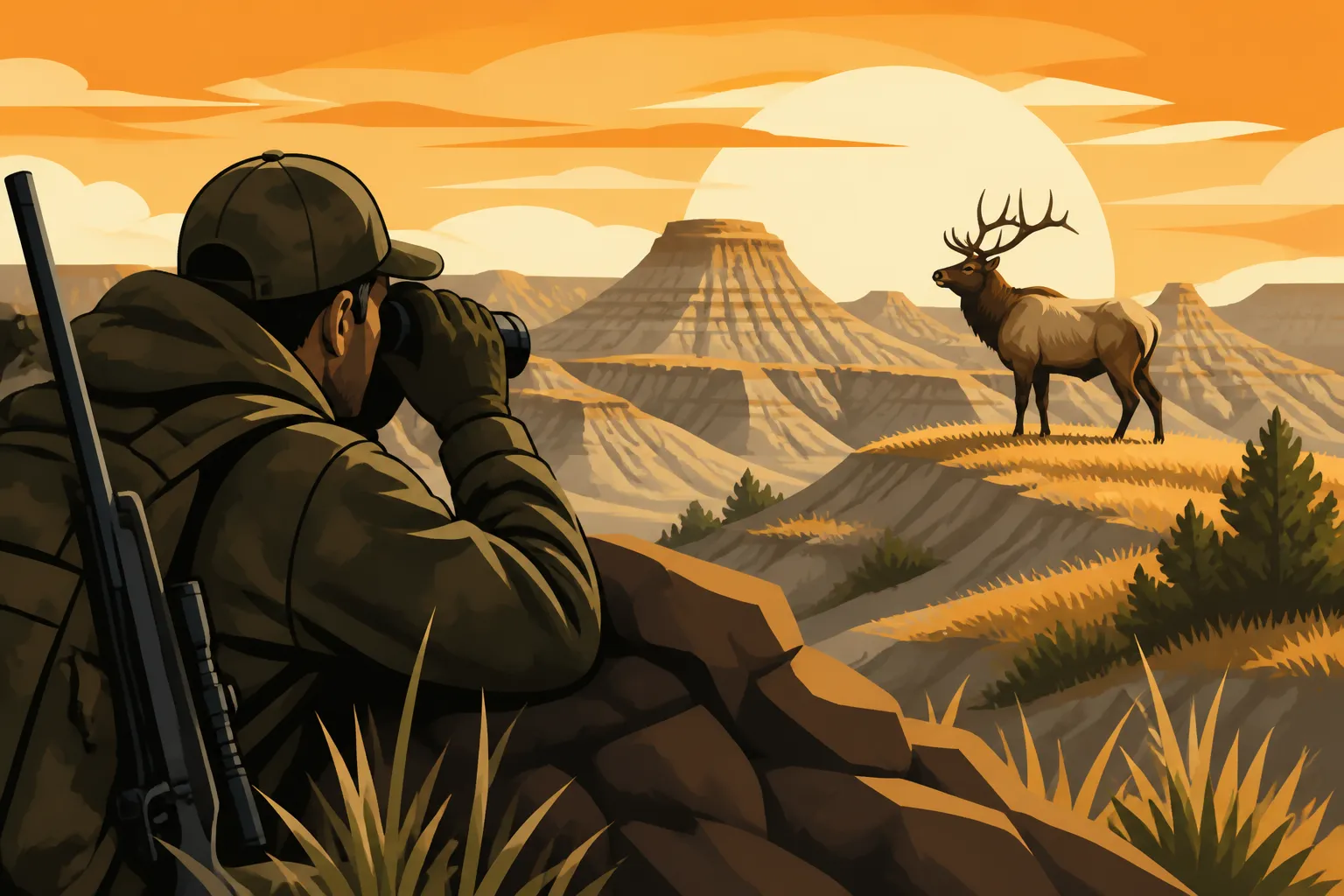
The Badlands are characterized by deeply eroded buttes, mesas, and ravines, sculpted by centuries of wind and water. You'll encounter sharp elevation changes, often dropping hundreds of feet into a hidden draw or climbing steep, crumbly slopes. The vegetation here is a mix of sparse prairie grasses on the open ridges, pockets of juniper and cedar on the north-facing slopes, and cottonwoods and willows in the bottomlands along seasonal drainages and the Little Missouri River itself. Elk, being large animals, need cover to feel secure and to move unobserved. They'll often utilize those thick stands of juniper and cedar for bedding, especially during the heat of the day or when facing strong winds. The cottonwood bottoms provide not only shade and cover but also crucial forage, particularly as the season progresses. Understanding these micro-habitats within the larger Badlands system is key. You'll rarely find elk just standing out in the middle of a vast, open prairie in this region; they're almost always associated with some form of broken country or timber.
Seasonal Elk Movement Patterns
Elk movements in the Badlands are highly dependent on the time of year and prevailing weather conditions. During the early archery season, elk might still be in larger summer herds, but as the rut approaches in late September and October, bulls become more vocal and less predictable, often seeking out cows in smaller groups. As the weather cools and especially once the gun season starts, pressure from other hunters can push them into the deepest, most inaccessible parts of the Badlands. They often gravitate towards thermal cover on north-facing slopes when it's cold or windy, and seek shade in dense pockets of timber during warmer spells. Post-rut, bulls tend to separate and can be solitary, making them even harder to locate. It’s also worth noting that if a significant snowfall hits, elk will move to areas where forage is easier to access, often on windswept ridges or down into protected valleys where snow accumulation is less severe. Keeping an eye on weather forecasts and understanding how these animals react to changes is paramount. You can find more detail on their behavior in How Many Elk Live in the Badlands.
Water Sources and Bedding Areas
Water is life, especially for large animals like elk, and in the often-arid Badlands, knowing where to find it is a huge advantage. Elk will frequent stock ponds, springs, and stretches of the Little Missouri River. During dryer periods, these water sources can become magnets for game. Knowing the location of every reliable water hole within your hunting unit, even the small ones that might just hold water after a rain, can reveal predictable travel corridors. Bedding areas are typically located on elevated terrain that offers both cover and a commanding view of the surrounding landscape. Elk love to bed on benches on a hillside, allowing them to spot danger approaching from below while also having a quick escape route over the top. Dense juniper patches, deep coulees with good thermal protection, and even the leeward sides of prominent buttes can all serve as prime bedding locations. Understanding these patterns, sometimes with the help of resources like the GoHunt app which can show water sources and historical animal movements, will significantly narrow down your search area.
Essential Gear for a Badlands Spot-and-Stalk Elk Hunt
Successfully executing a spot-and-stalk hunt in the Little Missouri Badlands hinges on having the right equipment. This isn't a casual stroll; it's a demanding expedition that requires durable, reliable gear to keep you safe, comfortable, and effective.
Optics: The Foundation of Spotting
Without exceptional optics, your spot-and-stalk hunt is dead in the water before it even begins. You’ll be spending a substantial portion of your day behind glass, meticulously picking apart distant hillsides and coulees. A high-quality spotting scope, ideally with a 60-80mm objective lens and 20-60x magnification, is non-negotiable for identifying elk at extreme ranges. Look for one from a reputable brand known for clarity and light gathering, even in challenging low-light conditions. Pair this with a sturdy, lightweight tripod, as hand-holding a spotting scope for extended periods is impossible for precise glassing.
Your binoculars are equally critical. A good pair of 10×42 or 12×50 binoculars will be your primary tool for scanning closer terrain and initially locating animals. Again, invest in the best you can afford. The clarity and field of view will make a significant difference in reducing eye strain and increasing your ability to pick out subtle movements or parts of an animal. Many hunters also find a rangefinder invaluable, especially one with angle-compensation capabilities for those steep Badlands shots. When you're glassing from a distant ridge, identifying an elk is one thing, but confirming its size, sex, and precise location, and then determining if a stalk is even feasible, requires top-tier glass. For more on strategic glassing, check out Glassing Badlands Coulees for Elk.
Here's a quick comparison of typical optics you'd carry:
| Optic Type | Typical Magnification | Primary Use | Key Feature | Weight Consideration |
|---|---|---|---|---|
| Binoculars | 10x-12x | Initial scanning, closer range observation | Wide field of view, portable | Moderate |
| Spotting Scope | 20x-60x (or higher) | Long-range identification, detailed examination | High magnification, crucial for detail | Heavier, requires tripod |
| Rangefinder | 6x-10x | Distance measurement, angle compensation | Precision at varying distances | Lightweight |
Footwear, Clothing, and Backpack Essentials
Your feet are your most important asset in the Badlands. Investing in high-quality, broken-in hiking boots with excellent ankle support and waterproof membranes is crucial. The terrain is unforgiving, with loose rock, steep grades, and potentially thorny vegetation. Merino wool socks are another must-have, providing cushioning, moisture-wicking properties, and odor resistance. Layering is the name of the game for clothing. The Badlands can experience drastic temperature swings from dawn to dusk, and even hour to hour. Start with a moisture-wicking base layer, add an insulating mid-layer (fleece or puffy jacket), and top it with a durable, quiet, and windproof/water-resistant outer shell. Remember, you’ll be moving a lot, so breathability is important to prevent overheating and sweating.
Your backpack needs to be comfortable and capacious enough for a full day's gear, plus the potential to pack out meat. A pack in the 35-50 liter range is often suitable for day hunts, but if you plan on packing out significant portions of an elk, consider a pack with a strong frame and load-hauling capabilities. Essentials include a first-aid kit, emergency shelter, headlamp, fire starter, knife, water purification, and plenty of high-energy snacks. Even if you're planning a day trip, this region is remote, and you need to be prepared for an unexpected night out. Packing for an Eight-Day North Dakota Elk Hunt provides an even more comprehensive list.
Weapon Choice and Ammunition Considerations
When it comes to weapon choice, you need something you're proficient and confident with, especially given the potential for longer shots in open country. For rifle hunters, a flat-shooting cartridge like a .270, .30-06, 7mm Rem Mag, or .300 Win Mag is popular for elk, paired with quality, heavy-for-caliber bullets designed for deep penetration on large game. Practice shooting from various positions – prone, kneeling, and using your backpack as a rest – as a bench rest might not be an option in the field.
Bowhunters face an even greater challenge with spot-and-stalk elk. Shots are typically closer, but getting within ethical range in open terrain requires incredible stealth. A reliable compound bow, tuned and sighted in, is essential. Broadheads should be sharp, robust, and designed for elk, whether fixed-blade or mechanical. Regardless of your weapon, practice, practice, practice. Know your effective range and stick to it. The Badlands don’t forgive marginal shots, and recovering a wounded elk in this country can be a monumental task. The GoHunt Gear Shop can be a valuable resource for comparing different weapon and optics options, helping you make informed decisions based on expert reviews and user feedback.
Mastering the Art of Spotting Elk in Rugged Terrain
The Badlands can swallow an elk whole, even a bull with a massive rack. Learning to effectively spot these animals in such complex terrain is a skill that takes patience and practice. It’s not just about looking at the landscape, but truly seeing into it.
Strategic Glassing Techniques
Effective glassing isn't just randomly sweeping your binoculars across the landscape. It's a deliberate, systematic process. Find a high vantage point that allows you to see into multiple coulees, draws, and hillsides, ideally with the sun at your back or at least not directly in your eyes. Use your binoculars to break down the distant landscape into small, manageable grids. Start at the nearest points and slowly work your way out, paying close attention to any changes in color, texture, or shape that seem out of place. Look for horizontal lines (an elk's back or belly) in a predominantly vertical world (trees, grass stems), or a patch of solid color that doesn't quite match the surrounding vegetation.
After a thorough scan with your binoculars, switch to your spotting scope for a more detailed examination of areas that look promising or where you might have glimpsed something ambiguous. Elk often blend in incredibly well, so you might only pick up an ear twitch, the flick of a tail, or the glint of an antler tip. Don't be afraid to sit in one spot for an hour or more, letting your eyes adjust and allowing animals to reveal themselves as they move. Early morning and late evening are prime glassing times, as elk are often most active during these periods. Patience here truly pays dividends; rushing your glassing will almost guarantee you miss something important.
Using Topographical Maps and Satellite Imagery
Before you even set foot in the Badlands, modern mapping tools are your secret weapon. Platforms like GoHunt Maps, or even Google Earth, allow you to study the terrain from the comfort of your home. Identify potential bedding areas (dense timber on north-facing slopes, secluded benches), probable travel corridors (ridges connecting food to water, drainages), and escape routes. Pay attention to saddle points, which are often used by animals to cross from one drainage to another. Look for areas with a mix of cover, water, and forage.
Overlay satellite imagery with topographical lines to get a sense of elevation changes and vegetation density. This pre-scouting helps you formulate a game plan, deciding where to glass from and identifying potential stalking routes. It also allows you to anticipate where elk might move under different wind conditions. While nothing beats boots on the ground, a solid understanding of the terrain from above will save you countless wasted steps and help you focus your efforts. For example, knowing Wind and Thermals in Badlands Terrain from your map work can inform where you might find elk bedded to avoid prevailing winds.
Reading Wind and Thermals in Badlands Terrain
The wind and thermals in the Badlands are notoriously tricky and can make or break a stalk. Due to the broken topography, wind currents can swirl unpredictably, especially in deep coulees. Generally, in the mornings, thermals rise as the sun heats the ground, pulling your scent uphill. In the evenings, as the air cools, thermals drop, carrying your scent downhill. However, a strong crosswind or the shape of a particular coulee can completely override these general rules.
Always be aware of the wind direction relative to your position and the elk's. Use a wind checker (talcum powder, milkweed seeds) constantly. Never, ever approach an elk from directly downwind unless you want to watch it disappear over the next ridge. Try to approach from a crosswind direction, or even slightly upwind if the terrain allows for a super stealthy approach. Understanding these complex air currents, often by observing leaves, grass, or even carrying a small flag, is crucial for remaining undetected. A shifting thermal can ruin hours of careful stalking in a matter of seconds.
The Stalk: Approaching Elk Undetected
Once you’ve spotted an elk and decided it’s an animal you want to pursue, the real chess match begins. The stalk is a delicate dance of patience, stealth, and using the terrain to your advantage.
Evaluating the Stalking Route
Before you take a single step, spend ample time observing the elk and the surrounding terrain through your spotting scope. Identify their exact location, how they’re positioned (bedded, feeding, moving), and critically, what their escape routes are. Then, meticulously map out your approach. Look for natural features like ridge lines, deep draws, or thick timber that can provide cover. Your goal is to get within effective shooting range without being seen, heard, or smelled.
Consider the prevailing wind and thermals and how they might shift during your stalk. What looks like a perfect approach on paper might be a death trap if the wind swirls into a thermal hole. Have a backup plan or two. What if the elk moves? What if you encounter unexpected cover or another animal? The Badlands are full of surprises. Sometimes the best decision is to wait, even for hours, until the elk moves into a more favorable position or the lighting changes. Rushing a stalk is a common mistake that often leads to blowing your opportunity. When considering how far elk might move, it can be helpful to think about concepts like Where Badlands Bucks Bed and how those same principles apply to elk.
Utilizing Cover and Topography Effectively
The broken landscape of the Badlands, while challenging, is also your greatest asset during a stalk. Use every fold, every rise, every juniper bush to your advantage. Move slowly, deliberately, and with purpose. When you need to cross an open area, time it with the elk’s head down or when its vision is obstructed. If it's feeding, use the moments its head is down to make your moves. When its head is up, freeze completely. Your silhouette against the skyline is a dead giveaway, so try to stay below ridge lines or move along their sides.
Think like the elk. What would they see? Where are the visual barriers? Where can you move without making a sound on loose rock or dry leaves? Sometimes the best path isn't the shortest one, but the one that offers the most consistent cover. A good technique is to move from "cover to cover," always having your next hiding spot in mind before you leave your current one. This meticulous attention to detail is what separates a successful stalk from a blown opportunity.
Managing Noise and Scent
Noise and scent are two of the biggest killers of an elk stalk. The Badlands can be incredibly quiet, making even a misplaced footstep sound like a thunderclap. Wear quiet clothing that doesn't rustle. Take small, controlled steps, feeling the ground before you commit your weight. Avoid snapping twigs or dislodging rocks. If you’re moving through brush, try to part it gently rather than forcing your way through.
Scent is even harder to control. Elk have an incredible sense of smell. Always play the wind, as discussed earlier. Use scent-eliminating sprays on your clothes, though these are often only a temporary solution. The most effective strategy is to approach from a direction where your scent will be carried away from the elk. If the wind is swirling or unpredictable, it might be best to abandon the stalk and try again later or find a different animal. This is where modern tools like the GoHunt app can sometimes provide real-time wind data to help you make informed decisions, especially in complex topography. Carrying a small bottle of talcum powder or milkweed seeds to constantly check the localized wind currents is also a smart move.
Shot Placement and Recovery in Challenging Conditions
After all the effort of spotting and stalking, the shot is the moment of truth. In the Badlands, a clean, ethical shot is paramount, not only for the animal's welfare but also because recovering a wounded elk in this unforgiving terrain can be a nightmarish experience.
Ethical Shot Selection
Before you even raise your weapon, take a moment to confirm the target. Are you sure it’s an elk? Is it the right size or sex for your tag? This sounds basic, but in the heat of the moment, mistakes can happen. Once confirmed, wait for a clear, unobstructed shot at the vitals. For elk, the ideal shot is typically broadside or slightly quartering away, aiming for the heart-lung area just behind the front shoulder. Avoid head-on shots or shots at the hindquarters, as these offer a much smaller target area for vital organs and a higher risk of wounding.
Consider your range. Are you within your effective and ethical shooting distance? If you're a rifle hunter, know your bullet drop at various ranges. If you're bowhunting, ensure you can make a clean shot without hitting any intervening branches. If the shot isn't perfect, or if the elk is moving too quickly or obscured, don't take it. The most ethical decision is often to let the animal walk away, even after a long, difficult stalk. Another opportunity will arise. Rushing a shot leads to regret and potentially a lost animal. It's a testament to good sportsmanship and respect for the game to only take high-percentage shots.
Tracking and Recovery Strategies
Even with a perfect shot, elk are tough animals and can often travel a good distance before succumbing. Mark the exact spot where the elk was standing when you shot, and where you last saw it. Pay attention to any visual cues—how the elk reacted, if it flinched, dropped, or bolted. Before rushing in, give the animal time. For rifle-shot elk, waiting 20-30 minutes can allow the animal to expire nearby. For bow-shot elk, especially if the hit wasn't ideal, waiting 4-6 hours, or even overnight if conditions allow, is often recommended to prevent pushing the animal further.
When you begin tracking, move slowly and methodically. Look for blood, broken branches, disturbed earth, or even tufts of hair. If the blood trail is sparse, expand your search pattern in the direction the elk was last seen. Elk often follow paths of least resistance, such as game trails, creek beds, or ridge lines. If you lose the trail, back out to the last confirmed sign and try again. Don’t be afraid to enlist the help of a tracking dog if legal and available, or extra hunters if the situation calls for it. Recovering a deer or elk, especially in the challenging terrain of the Badlands, is a test of determination. The North Dakota Game and Fish Department offers resources for Blood Trailing After Dark in North Dakota, which can be particularly useful.
Field Dressing and Meat Care in Remote Areas
Once the elk is down, the clock starts ticking, especially if temperatures are warm. You need to field dress the animal as quickly and efficiently as possible to begin the cooling process. Remove the entrails to allow body heat to dissipate, which prevents spoilage. If you plan to quarter the animal to pack it out, learn the "gutless method," which allows you to remove all the meat without ever having to eviscerate the animal, saving weight and mess.
Have game bags ready to protect the meat from dirt, flies, and debris. These breathable bags are essential for keeping the meat clean while it cools and during the pack out. In the Badlands, you’re often far from your vehicle, so be prepared for a difficult pack out over rough terrain. This is where proper physical conditioning, as highlighted in Physical Prep for Badlands Elk Terrain, really pays off. If you’re hunting alone, consider quartering the animal and making multiple trips, or having a heavy-duty frame pack. Get the meat cooled down as quickly as possible, whether by hanging it in the shade or covering it with ice once you get it back to camp or your vehicle. Proper meat care ensures that all your hard work translates into delicious wild game for your freezer.
Disclaimer
Hunting is an inherently risky activity. Always prioritize safety, adhere to all North Dakota hunting regulations, and ensure you have the necessary licenses and permits. The information provided here is for educational purposes and should not replace official guidance from the North Dakota Game and Fish Department or professional safety instruction.