Badlands Deer Density
There’s a unique kind of challenge that comes with hunting North Dakota’s Badlands, especially when you’re trying to wrap your head around where the deer actually are. It’s not like the prairie pothole region where you might spot a dozen whitetails in a quarter section of standing beans. The Badlands are vast, broken, and can feel utterly devoid of life one minute, only to reveal a hidden pocket of deer the next. This guide is all about dissecting what "deer density" means in this rugged landscape and how you can use that understanding to your advantage, turning those frustrating empty hours into successful hunting experiences.
Understanding Deer Density in North Dakota's Badlands
When we talk about deer density in the Badlands, it’s not always a straightforward number like "X deer per square mile." This isn't a fenced-in preserve; it's a wild, dynamic environment where deer populations ebb and flow, and their distribution is heavily influenced by the terrain itself. For hunters, understanding this is less about precise census figures and more about recognizing patterns and hot spots.
What "Deer Density" Actually Means Here
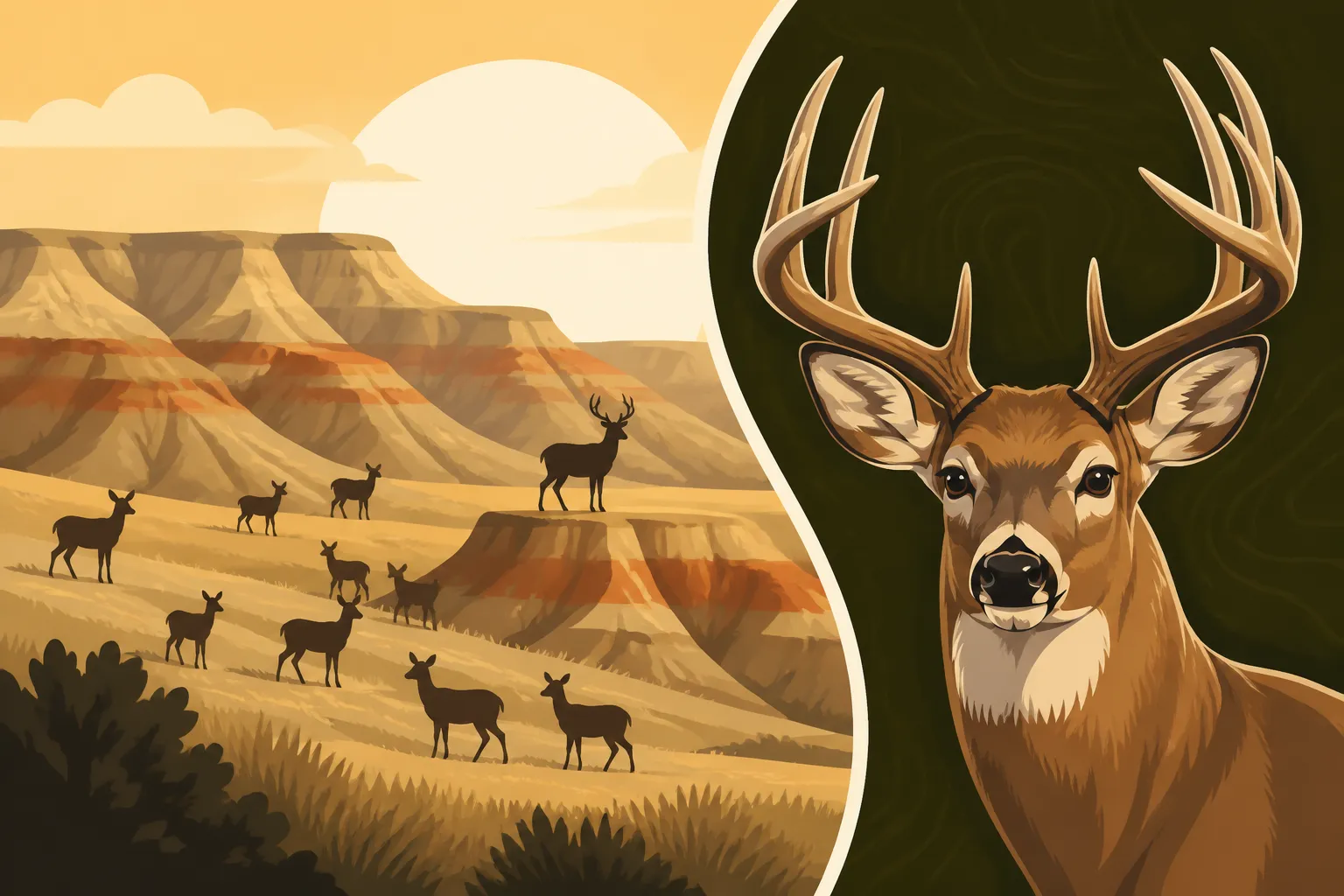
In the context of hunting the North Dakota Badlands, "deer density" is often more about perceived density—where deer are concentrated and thus more huntable—rather than a uniform distribution across every acre. You might have a unit with an overall moderate deer density, but 90% of those deer could be holed up in 10% of the habitat. Think of it as pockets of life in an otherwise expansive and often sparse landscape. It’s the difference between knowing there are deer somewhere in the unit and knowing exactly which coulees, draws, and river breaks they call home. This focus on localized density is crucial for success, especially when considering a hunt for Mule Deer in North Dakota's Badlands.
The true density might be lower than what you’d find in the river bottom whitetail havens, but the sheer size and ruggedness of the Badlands make those deer incredibly elusive and often less impacted by hunting pressure. It means more time on the glass and more miles on your boots, but the rewards—a mature Badlands buck—are often well worth the effort. It's a game of finding those hidden pockets, rather than expecting deer around every corner.
Factors Influencing Badlands Deer Numbers
Deer populations, particularly in an environment as challenging as the Badlands, are constantly influenced by a myriad of factors. These aren't just static numbers; they're reflections of environmental health and survival rates. Knowing what affects these numbers helps you anticipate where and when deer might be more or less prevalent.
One of the biggest natural influencers is winter severity. A harsh North Dakota winter, especially one with prolonged deep snow and extreme cold, can take a significant toll on deer, particularly fawns and older animals. Conversely, mild winters can lead to higher fawn survival rates and a booming population. Disease outbreaks, like Epizootic Hemorrhagic Disease (EHD), can also drastically reduce local densities, leaving hunters scratching their heads after seeing a vibrant population disappear in a single season. We've also seen units added to North Dakota's Expanding CWD Hunting Units which can influence how deer are managed and harvested, potentially impacting local densities in targeted areas.
Habitat changes, both natural and man-made, play a role too. Droughts impact forage availability, pushing deer to seek out more reliable food and water sources, often concentrating them in different areas. Energy development, while bringing some disturbance, can also create new openings, food plots, or access roads that subtly alter deer movement and distribution patterns. Effective grazing management on public and private lands can either enhance or degrade habitat quality, directly impacting the number of deer an area can support. All these elements combined paint a complex picture of where deer might be found at any given time.
Mule Deer vs. Whitetail: A Density Divide
The Badlands are unique in North Dakota because they offer significant populations of both mule deer and white-tailed deer. While they often share the same general landscape, their preferred habitats within that landscape lead to distinct patterns of where you'll find them, creating different "density" zones for each species.
Mule Deer Concentration Areas
Mule deer are truly creatures of the rugged, broken country. When you’re glassing the Badlands, especially the deeply eroded draws and timbered breaks, you're looking for mule deer. Their numbers tend to concentrate in these steeper, more remote areas, far from human disturbance and often among the scattered pockets of ponderosa pine and juniper. They utilize the terrain for cover and escape, making them feel less "dense" even when their numbers are good, simply because they're so good at disappearing.
Think of the deep, twisting coulees of the Little Missouri National Grassland. These areas provide the perfect blend of cover, browse, and thermal protection that mule deer crave. They often bed on south-facing slopes in the sun on cold days, or on north-facing slopes in the shade during the heat of early season. Locating Where Badlands Bucks Bed often involves meticulous glassing, picking apart every shadow and juniper patch. Tools like GoHunt can be invaluable here, offering layered maps that highlight terrain features, vegetation, and public land boundaries, helping you identify potential mule deer havens before you even set foot on the ground. These concentrations might not appear as dense as a whitetail herd in an ag field, but they are there, tucked away in the rugged beauty.
Whitetail Strongholds in the Badlands
While mule deer prefer the high, rugged breaks, white-tailed deer in the Badlands are often found closer to the river and creek bottoms, or where the Badlands transition into agricultural land. The Little Missouri River, for instance, acts as a ribbon of life, providing consistent water, dense woody cover, and often more abundant forage due to richer soils. These riparian corridors are prime whitetail habitat, where you might see higher localized densities compared to the open, dry ridges.
Whitetails are more apt to stick to the heavier timber and brushy draws that offer better concealment and easier access to water. You'll find them along the main river, but also tucked into the winding creek drainages that feed into it, particularly where these areas meet isolated farm fields or shelterbelts. While the overall Badlands might be known for its mule deer, you'd be mistaken to overlook the potential for a trophy whitetail along these corridors. Understanding the differences in their preferred habitats is key to effectively targeting either species, and recognizing that even within the Badlands, White-Tailed Deer Across North Dakota exhibit specific preferences that create their own density patterns.
How to Interpret and Use Density Information for Your Hunt
Okay, so you know that Badlands deer density isn't a simple, evenly spread phenomenon. But how do you take that knowledge and actually put it to use on your hunt? It’s about being smarter, not just working harder. It’s about combining official data with real-world scouting and understanding deer behavior.
Beyond the General Numbers: Applying Data to Your Specific Unit
Statewide or even regional deer density numbers are a good starting point, but they rarely tell the whole story for your specific hunting unit, let alone the particular coulee you plan to hunt. The North Dakota Game and Fish Department provides unit-specific harvest reports and population trends that are far more valuable. These reports can show you not only the total harvest but also the buck-to-doe ratios and success rates for a given unit, which are strong indicators of the health and density of the local herd. A low success rate could mean lower density, or it could mean difficult terrain and wary deer.
However, even the best official data is just a snapshot. What you really need to do is combine that with your own boots-on-the-ground scouting, or at least a thorough virtual scouting session. Use aerial photos, topography maps, and tools like GoHunt to pinpoint likely habitat. Look for key features: water sources, north-facing bedding slopes (especially for mule deer), dense cover for escape routes, and travel corridors along ridge lines or creek beds. This detailed approach allows you to essentially "micro-target" areas within your unit that are likely to have higher huntable deer density, even if the overall unit average is low. This diligent preparation can be the difference between a tough hunt and a successful one, greatly aiding in Reading Aerial Photos for Badlands Deer.
Tools and Strategies for Locating Deer in Lower Density Areas
Hunting in lower density areas—which much of the Badlands truly is—requires patience, persistence, and a refined strategy. You can't just wander aimlessly and expect to stumble upon deer. You need to become a master of observation and movement.
One of the most effective strategies is extensive glassing. Find a high vantage point at first light and last light, and systematically pick apart every patch of cover, every fold in the terrain. High-quality optics are your best friend here. Don't just scan; study the landscape. Look for subtle movements, flicking ears, a patch of hide, or the tell-tale horizontal line of a deer's back against the vertical lines of the badlands. Mule deer often blend in incredibly well. Knowing how to effectively Glassing Badlands Coulees for Elk translates directly to finding deer in similar environments. Even in lower density areas, deer still have to move to feed, water, and bed. Understanding their daily patterns and how they use the terrain to their advantage, particularly with regard to Wind and Thermals in Badlands Terrain, can put you in the right place at the right time.
Modern technology also plays a massive role. GPS devices or mapping apps on your phone (like the GoHunt app) can overlay public land boundaries, topo lines, and even private land ownership, ensuring you stay legal and helping you navigate the complex terrain. You can drop pins on potential bedding areas, water sources, or observation points, building a strategy for your hunt. Even in sparse areas, these tools can help you identify subtle funnels or bottlenecks where deer movement might be concentrated, giving you an edge. For nonresidents, it's also worth familiarizing yourself with North Dakota Public Land Hunting Hours to maximize your legal hunting time.
| Aspect | Mule Deer in Badlands | Whitetail Deer in Badlands |
|---|---|---|
| Preferred Habitat | Steep, broken terrain, deep coulees, rocky breaks, juniper, pine pockets. | River bottoms, creek drainages, heavy riparian timber, agricultural interfaces. |
| Typical Movement | Utilize high points, contour lines, often more open and exposed when traveling. | Stick to dense cover, thicker brush, often travel within drainage bottoms. |
| Perceived Density | Often feels lower due to vast terrain and reclusive nature, but present in specific draws. | Can feel higher in concentrated corridors, especially along major waterways. |
| Hunting Strategy | Glassing from afar, spot-and-stalk, focus on bedding in rugged areas. | Still-hunting thickets, stand hunting along travel corridors, focused scouting near water. |
| Key Indicators | Tracks on ridgelines, rubs on ponderosa pines, distant bedded deer. | Rubs/scrapes in river bottom timber, heavy trails along creeks, browse lines. |
The Challenges and Rewards of Hunting in Varying Densities
Hunting in the North Dakota Badlands, particularly when dealing with varying deer densities, is a mental and physical game. It’s an experience that tests your resolve, but when it pays off, the satisfaction is unlike any other.
The Frustration of Low Density
Let's be real, there are days in the Badlands where you feel like you're hunting ghosts. You hike for miles, climb countless hills, and glass until your eyes ache, only to see nothing but prairie dogs and distant cattle. This kind of low-density hunting can be incredibly frustrating. It makes you question your choices, your abilities, and sometimes, even the existence of deer in the area. The vastness works against you, making every sign of deer—a track in the mud, a rubbed sapling, an old deer scat—feel like a monumental discovery. It can be easy to give up, to assume the deer just aren't there, or that the tag you drew was a fool's errand.
But that's the Badlands. It demands more from you. It teaches patience and resilience. You'll spend long hours meticulously picking apart every draw, wondering if you're even in the right zip code, let alone the right county. This is where the mental fortitude of a hunter is truly tested. It's a grind, and anyone who tells you otherwise is probably selling something. Embrace the struggle, because it's part of what makes the eventual success so incredibly sweet. Don't forget, even with lower densities, there are still deer to be found, often in the most improbable places, if you're willing to work for it, perhaps by Hunting Little Missouri's Backcountry Draws.
The Thrill of Finding High-Density Pockets
And then there are those moments. After hours or even days of seeing little, you crest a ridge, or peer into a seemingly insignificant fold of the earth, and there they are. A small pocket of mule deer browsing contentedly, or a cluster of whitetails working their way along a brushy creek bed. That’s the payoff. That's the thrill of finding those localized "high-density" pockets that only reveal themselves to the most persistent and observant hunters. It feels like unlocking a secret, discovering a hidden oasis of wildlife in the expansive wilderness.
The Badlands are full of these isolated honey holes. They might be a spring-fed pocket of green in a dry landscape, a sheltered coulee system offering thermal protection, or a secluded bench with perfect bedding cover. Once you find one, you realize that the deer density isn't universally low; it's simply unevenly distributed. You learn to adapt, to recognize the subtle cues of the land, and to trust your instincts. The hard work, the miles, the cold mornings—it all culminates in that moment when you finally put eyes on your target, making the entire journey worthwhile. This is the heart of what makes North Dakota Deer Harvest Records so interesting; each animal represents a triumph of hunting in such a unique environment.
Disclaimer
This article is for general informational purposes only and does not constitute professional advice. Laws, prices and regulations vary by location and change over time. Consult a qualified professional for guidance on your specific situation.