Hunting North Dakota’s Badlands Mule Deer Country
Hunting mule deer in North Dakota's rugged Badlands is a unique challenge that many hunters dream of but often feel overwhelmed by due to the vast, broken terrain and elusive nature of these animals. It's not like hunting whitetails in a shelterbelt; this requires a completely different approach, specialized gear, and a deep understanding of the landscape. This comprehensive guide will walk you through the specifics of successfully pursuing mule deer in this iconic western North Dakota region, helping you unravel the mysteries of this wild country.
Understanding the Badlands Ecosystem for Mule Deer
The North Dakota Badlands are an incredible, stark landscape, but they're also a challenging environment for both deer and hunters. Mule deer thrive here because the broken topography offers endless nooks, crannies, and draws for bedding and escape. Understanding this ecosystem is the first step to successful hunting.
Habitat Preferences and Movement Patterns
Mule deer in the Badlands aren't just roaming aimlessly; they have specific preferences that dictate their movements. They gravitate towards areas with adequate cover for bedding, which often means the steep, brushy draws, sagebrush flats, and pockets of juniper and ponderosa pine scattered throughout the landscape. These areas provide thermal cover in winter, shade in summer, and a sense of security from predators, including us hunters. During the day, particularly during hunting season, they'll typically bed down on north-facing slopes or in dense cover to avoid the sun and wind, often with a good vantage point to spot danger. Their movement patterns are highly influenced by food availability, water sources, and security. You'll find them browsing on forbs, shrubs, and even some grasses. Water, though often sparse, is a critical component, and deer will travel to seeps, stock ponds, or the Little Missouri River when necessary.
You can often predict their movements by considering the time of day and prevailing weather. Early mornings and late evenings usually find them actively feeding, often moving from bedding areas to more open areas or vice versa. The mid-day sun, especially during the archery or early gun seasons, pushes them into the thickest cover. When the rut kicks in, typically in early to mid-November, these patterns can become more erratic as bucks search for does, making them more visible but also more prone to moving through unexpected areas. This is why knowing When the North Dakota Rut Peaks can be a real game-changer for timing your hunt.
Key Forage and Water Sources
Identifying the crucial food and water sources is paramount to finding mule deer in the Badlands. Unlike agricultural areas where deer might concentrate on specific crops, Badlands mule deer utilize a wide variety of native plants. Look for areas with a mix of woody browse like buffaloberry, serviceberry, and sagebrush. Ponderosa pine needles can also be a food source, especially in winter. After a rain, you might find them grazing on new succulent forbs.
Water sources are often fewer and farther between, making them natural congregation points. These could be small stock ponds, natural seeps in coulees, or stretches of the Little Missouri River. Deer will often leave tracks and trails leading directly to these essential spots. Utilizing mapping tools like GoHunt, you can often identify potential water sources and green-up areas that indicate richer forage through satellite imagery, allowing you to focus your scouting efforts. Always remember that during dry spells, these water sources become even more critical and concentrated, funneling deer into predictable patterns. Conversely, after heavy rains, deer might utilize temporary puddles, spreading out their usage.
Essential Scouting Techniques for Badlands Mule Deer
You wouldn't just wander into a new city without a map, and you shouldn't approach the Badlands without thorough scouting. This isn't country you can just "show up and hunt"; preparation is key.
Pre-Season Digital Scouting
Before you even step foot in the Badlands, you should be doing extensive digital scouting. Tools like Google Earth, Gaia GPS, or specialized hunting apps from companies like GoHunt are your best friends. Start by studying topographical maps to understand the lay of the land, identifying major drainages, isolated pockets of timber, steep bluffs, and potential bedding areas. Look for north-facing slopes, which tend to hold more cover and provide thermal refuge, and analyze south-facing slopes, which often get more sun and can green up earlier, providing initial forage.
Focus on identifying pinch points, saddles between ridges, and distinct coulee systems that could funnel deer movement. Mark potential glassing points—high spots where you can overlook a vast amount of country. Pay attention to private land boundaries using plat maps within your mapping app, as this will help you navigate public access areas. You can also analyze historical satellite imagery to spot changes in vegetation or water levels over time, which can indicate shifting deer patterns. This digital groundwork allows you to prioritize areas for physical scouting, saving you precious time and effort once you’re on the ground. Think of it as creating your initial game plan, much like a quarterback studying opponent film.
Boots-on-the-Ground Reconnaissance
Once you've done your digital homework, it's time to hit the dirt. There's no substitute for boots-on-the-ground scouting. The Badlands can look vastly different from an aerial view. Walk the ridges, drop into the coulees, and explore the pockets of cover you identified digitally. Look for fresh tracks, rub lines, and scrapes, particularly along benches and natural travel corridors. Pay close attention to droppings to gauge deer activity and recent presence.
One of the most valuable aspects of ground scouting is finding fresh buck sign. Shed antlers, though often picked over, can give you an idea of buck presence from the previous winter. More importantly, fresh rubs on small trees and bushes, and well-used game trails leading into dense cover, are strong indicators. Try to locate actual bedding areas—thick patches of juniper, a small stand of pines on a sheltered slope, or a dense pocket of brush at the head of a coulee. These are the places Where Badlands Bucks Bed and where you'll want to focus your efforts during the season. Remember to also look for areas with good escape routes for the deer, as they rarely bed in places where they can't quickly vanish.
Effective Hunting Strategies in Broken Country
Hunting the Badlands for mule deer demands patience, smart movement, and keen observation. This isn't a place for casual strolling; it's a game of chess.
Spot and Stalk Mastery
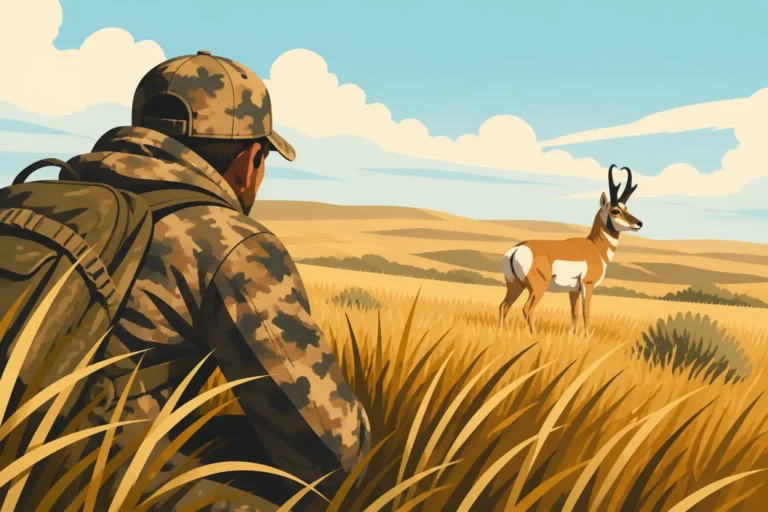
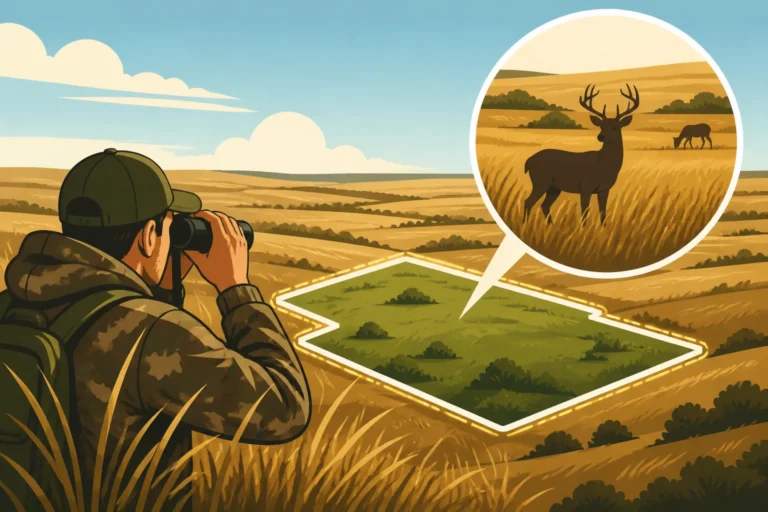
The spot and stalk method is king in the Badlands. The wide-open nature of much of the terrain, interspersed with deep draws, makes it ideal for finding deer from a distance and then carefully planning your approach. Start by finding a high vantage point at first light or late in the evening. Use good optics – 10x or 15x binoculars on a tripod, or a quality spotting scope – to systematically pick apart the landscape. Focus on scanning benches, ridge lines, and the edges of heavy cover. Take your time, sometimes an hour or more in one spot, letting your eyes adjust and focusing on patterns that break up the natural lines of the landscape. Mule deer often blend in incredibly well.
Once you spot a buck, the real challenge begins. This is where the broken terrain becomes both your friend and your enemy. Use the folds and cuts in the landscape to hide your approach. Always pay attention to Wind and Thermals in Badlands Terrain; an errant breeze can ruin a stalk in seconds. Plan your route meticulously, moving slowly and deliberately, taking advantage of every bit of cover. Sometimes, a stalk might take hours and cover significant distance. Patience is paramount; rushing will almost certainly lead to blowing out the deer. If you lose sight of the animal, pause, relocate, and re-evaluate. It’s better to take a little more time and ensure a clean shot than to bump a trophy buck.
Utilizing Wind and Thermals
Understanding and using wind and thermals correctly is non-negotiable for successful Badlands mule deer hunting. The erratic nature of the wind in this broken terrain is a major frustration for many hunters. In the mornings, as the sun rises, thermals generally pull scent uphill. In the evenings, as the sun sets and the air cools, thermals tend to drop scent downhill into the valleys and coulees. During the middle of the day, or on windy days, these thermal patterns can be heavily influenced by the prevailing wind, making things even more complex.
Always carry a wind checker, like a small bottle of powder or thread. Before making any move on a spotted animal, check the wind and thermals from your current position and try to anticipate how they will shift as you move. This means often taking circuitous routes to stay downwind or cross-wind of the deer. Remember that mule deer rely heavily on their sense of smell. If they catch your scent, the hunt is over. Be aware that scent can swirl in coulees and pockets, so what feels like a good wind on a ridge might be entirely different down below. Plan your approach with multiple wind checks in mind, and always have a backup plan if the wind shifts unexpectedly.
Glassing Badlands Coulees for Elk and Mule Deer
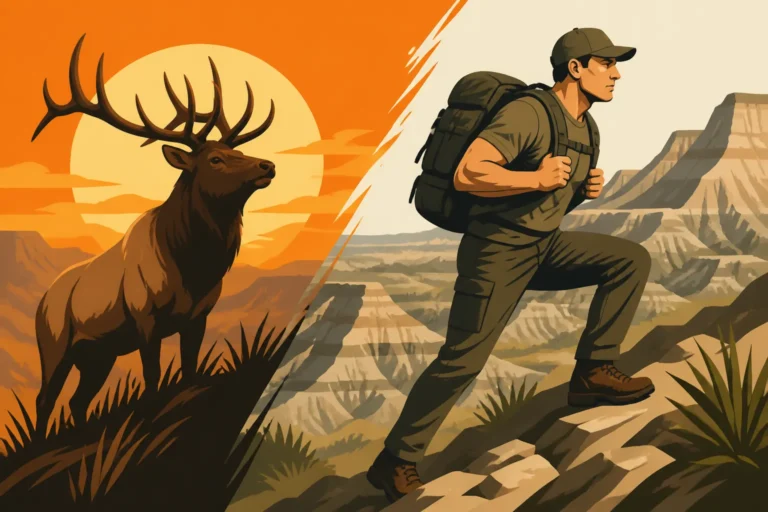
Glassing is arguably the most crucial skill for hunting mule deer in the Badlands. It saves you miles of walking and allows you to cover vast amounts of country efficiently. While you might be specifically targeting mule deer, applying the same techniques you'd use for larger game like elk is incredibly effective in this type of habitat. Think about Glassing Badlands Coulees for Elk; those very same principles apply here.
Find a high point with a panoramic view and set up your tripod-mounted binoculars or spotting scope. Start by dividing the landscape into grids and systematically scan each section, moving slowly. Don't just look for an entire deer; look for parts of a deer – an antler tip, a horizontal line in a vertical world, the flick of an ear, a patch of hide that doesn't match the surroundings. Mule deer often blend in perfectly, especially when bedded. Pay particular attention to shady slopes, the heads of coulees, and dense juniper patches. Scan, pause, and let your eyes process what you're seeing. Often, it's on the second or third scan of an area that an animal will materialize. Use the sun to your advantage, glassing with the sun at your back in the mornings and evenings to illuminate deer in shadows.
Navigating Public Access and Regulations
North Dakota offers some excellent public land opportunities, but navigating them, especially in the Badlands, requires careful attention to rules and boundaries.
Understanding PLOTS and National Grasslands
Public Lands Open To Sportsmen (PLOTS) are a fantastic resource in North Dakota, offering public access to private land. However, these tracts can change yearly, and their boundaries are critical. Always use the most current PLOTS guide or the ND Game and Fish app to verify you are on an open tract. Non-residents, be aware of the "Nine-and-a-Half-Day Bow Restriction" for hunting on PLOTS land; you generally need to wait until September 15th to hunt deer on PLOTS land as a non-resident bowhunter. Understanding these specific dates is key to avoiding legal issues, as detailed in How Many Days Nonresidents Wait for Public Land Bow Access.
Beyond PLOTS, much of the western Badlands falls within the Little Missouri National Grassland. This federal land offers vast opportunities for mule deer hunting. However, even here, specific regulations apply. For example, there are rules regarding vehicle access, camping, and baiting. It’s crucial to know that Why Baiting Is Banned on National Grasslands, for instance, can impact your hunting strategy. Always consult the North Dakota Game and Fish Department (NDGFD) regulations and the U.S. Forest Service rules for the National Grasslands to ensure compliance. Ignorance of the law is not a valid defense, and a simple mapping app like GoHunt can help you visualize these boundaries clearly on your phone or GPS device.
Respecting Private Land Boundaries
North Dakota is largely private land, and respecting those boundaries is not just a legal requirement, but a fundamental ethical principle of hunting. Even on public land, many tracts are surrounded or interspersed with private property. This means constant vigilance with your mapping tools is necessary. Property lines can be hard to discern on the ground, especially in rugged terrain, so rely on your GPS and mapping apps that show public and private land layers.
If you suspect a deer you shot has crossed onto private land, the law in North Dakota generally requires you to obtain permission from the landowner before you can retrieve it. This can be a tense situation, so having a plan beforehand, and carrying landowner contact information if possible, is wise. The best practice is to always know exactly where you are and where the property lines are. If in doubt, stay out. Building a good reputation among landowners is crucial for all hunters, even those primarily hunting public land, as it protects access for everyone.
Gear and Physical Preparation for the Badlands
The Badlands are beautiful but unforgiving. Your gear needs to be up to the task, and your body needs to be ready for the demands of the terrain.
Essential Optics and Footwear
Your optics are your most important tool, second only to your weapon. As mentioned, high-quality binoculars (10x or 12x), preferably on a tripod or steady rest, are critical for glassing vast expanses. A spotting scope (15-45x or 20-60x) is also highly recommended for identifying specific animals at extreme distances, especially if you're trying to judge antler size from a mile away. Don't skimp on quality here; clear glass makes all the difference when mule deer are blending into the landscape.
For footwear, prioritize comfort, support, and durability. The Badlands terrain is steep, rocky, and can be slippery when wet or icy. A good pair of broken-in, waterproof hiking boots with excellent ankle support is essential. Look for boots with aggressive tread for grip. Many hunters prefer a stiffer sole for side-hilling and navigating rocky areas. Blisters can quickly derail a hunt, so proper boot fit and quality socks (wool or synthetic) are non-negotiable. Always carry moleskin or a blister kit.
Packing Smart for Remote Hunting
When hunting the Badlands, you'll often be miles from your vehicle, and self-sufficiency is key. Your pack needs to carry everything you need for the day, and potentially for an overnight emergency. Think about the "ten essentials": navigation (GPS/map/compass), headlamp, sun protection, first-aid kit, fire starter, knife, shelter (emergency blanket), extra food, extra water, and extra layers. Beyond that, consider items specific to hunting mule deer: rangefinder, game bags, sharpening stone, small saw or hatchet for quartering.
Water is particularly important in the Badlands, especially during warmer early seasons. You'll sweat more than you think traversing those coulees. Carry more water than you think you'll need, or bring a reliable water filter. Layers of clothing are crucial as temperatures can fluctuate wildly between early morning and midday. Pack light, but pack smart. If you are successful, you will need to pack out a mule deer, often in pieces. This means having space and capacity in your pack for meat, or having a dedicated frame pack. Consider Packing for an Eight-Day North Dakota Elk Hunt for inspiration on what to carry for challenging multi-day hunts in similar rugged terrain; many of those principles apply directly to a deep Badlands mule deer hunt.
Physical Conditioning for Rugged Terrain
This isn't a walk in the park. Hunting mule deer in the Badlands demands significant physical stamina and preparation. You'll be climbing steep, shale-covered hills, dropping into deep coulees, and traversing uneven terrain, often with a pack. The elevation changes might not be as dramatic as in the Rockies, but the constant up-and-down, coupled with the sheer distances, will wear you out quickly if you're not in shape.
Start a fitness regimen well before your hunt. Focus on cardiovascular endurance (hiking, running, stair climbing) and strength training, particularly for your legs and core. Practice hiking with your loaded hunting pack to simulate real-world conditions. Many hunters find that incorporating exercises that mimic the movements of climbing and descending steep hills is incredibly beneficial. Don't underestimate the mental toughness required either; pushing through fatigue in challenging terrain is part of the Badlands experience. Being physically prepared not only increases your chances of success but also significantly enhances the safety and enjoyment of your hunt.
Managing Expectations and Embracing the Challenge
Hunting the North Dakota Badlands for mule deer is a privilege and an adventure. It's not always about punching a tag, but about the experience of being in this wild, beautiful place.
Realistic Success Rates
Let's be real: hunting mule deer in the Badlands is tough. Tags are often limited, and the deer are smart and elusive. Success rates vary year to year and by unit, but generally, they are not exceedingly high. This isn't a high-volume deer harvest destination like some whitetail units. This is a trophy hunt, both for the quality of the animal and the quality of the experience. Go into your hunt with realistic expectations about your chances of success. It might take multiple trips, or even years, to connect with a mature Badlands buck.
The reward isn't just the harvest; it's the intense challenge, the stunning scenery, the self-reliance, and the knowledge that you've pushed yourself in a truly wild environment. Focus on the process: the scouting, the stalk, the learning. If you harvest a buck, that's the icing on the cake. If not, you've gained invaluable experience and spent time in one of North Dakota's most iconic landscapes.
The True Spirit of a Badlands Hunt
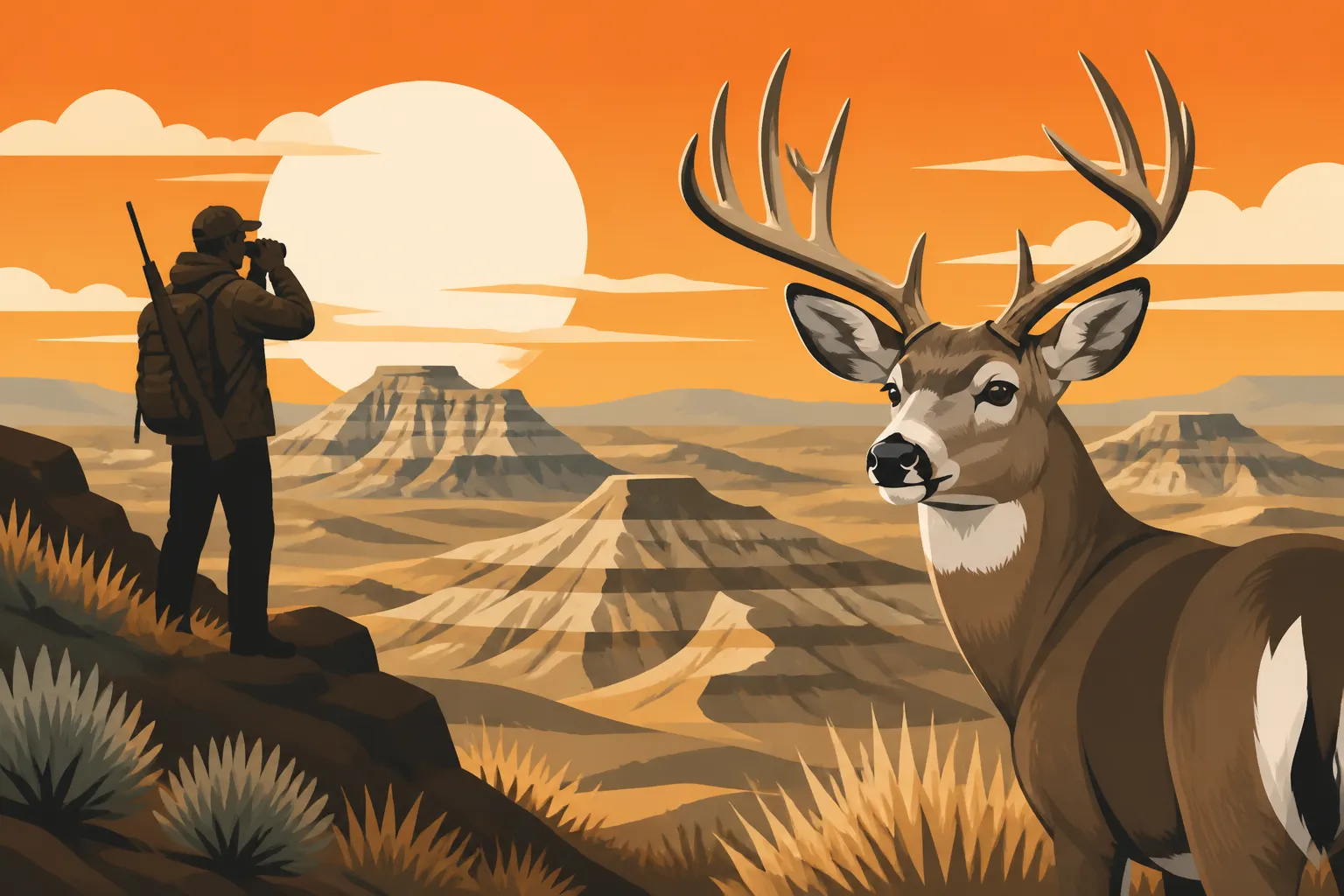
A Badlands mule deer hunt is about more than just the deer. It's about immersing yourself in a landscape that feels ancient and wild. It's about waking up before dawn to crisp, silent air, watching the sunrise paint the buttes and coulees with vibrant colors. It's about the solitude, the challenge of navigating complex terrain, and the satisfaction of spotting an animal through your optics after hours of careful scanning.
This is a hunt that tests your patience, your physical limits, and your mental fortitude. It forces you to slow down, pay attention to the details of the land, and appreciate the raw beauty of North Dakota. Whether you come home with a buck or just incredible memories and a deeper connection to the wild, the true spirit of a Badlands hunt lies in the journey, the pursuit, and the respect you gain for this incredible animal and its rugged home. It's an experience that stays with you long after the season ends.
Disclaimer
Please remember that hunting regulations, season dates, and license requirements can change. Always consult the most current North Dakota Game and Fish Department (NDGFD) regulations before planning any hunting trip. This guide is for informational purposes only and should not be considered a substitute for official regulations.