Reading North Dakota Mud for Fresh Deer Movement
There’s nothing quite as frustrating as trudging through fields, coulees, and shelterbelts, seeing deer sign everywhere, but struggling to figure out if it’s from last night or last week. The prairie can be a harsh mistress, quickly drying out evidence or washing it away, leaving you guessing. But when the ground is soft from a recent rain or thaw, North Dakota mud becomes your best friend, offering a literal footprint into the real-time movements of the deer you’re chasing. This guide is all about honing your skills to decipher those muddy messages, helping you pinpoint fresh deer activity and dramatically improve your hunting success.
Understanding the Subtle Language of Deer Tracks in North Dakota Mud
When you're out in the field, especially after a good rain, the mud on the ground isn't just an inconvenience; it's a dynamic canvas displaying the most recent chapters of a deer's life. Learning to read these imprints correctly is a skill that takes time, but the rewards are immense. It’s about more than just seeing a hoof print; it’s about understanding the subtle nuances that tell you if that deer just walked by, or if it was a ghost from seasons past.
Differentiating Whitetail and Mule Deer Tracks
North Dakota is home to both whitetail and mule deer, and while their tracks can look similar at a glance, there are often subtle differences, especially in their gait and how they utilize terrain. Whitetail tracks tend to be more pointed and heart-shaped, with the two halves of the hoof often closer together. They're also known for their powerful, driving gait, which can leave deeper, more distinct tracks, particularly when they're moving at a good clip or bounding. You'll often find whitetail tracks following cover, like the edge of a cornfield or a thick shelterbelt, reflecting their preference for security.
Mule deer, on the other hand, often leave a track that appears a bit more rounded or blunt at the toe, and the two halves of the hoof can sometimes splay out a bit more, especially on softer ground or when they're pushing through deep mud. Their distinctive bounding gait, often described as a "stotting" or "pogo stick" motion, means their tracks might appear in more distinct pairs, or spread out in a way that shows all four feet hitting the ground in quick succession when alarmed. In the rugged Badlands, you’ll find mule deer tracks traversing steep slopes and open country, areas where a whitetail might hesitate. Understanding these basic differences can help you confirm the species you’re after and whether you’re in prime Mule Deer in North Dakota's Badlands territory or a whitetail haven.
How to Gauge Track Freshness
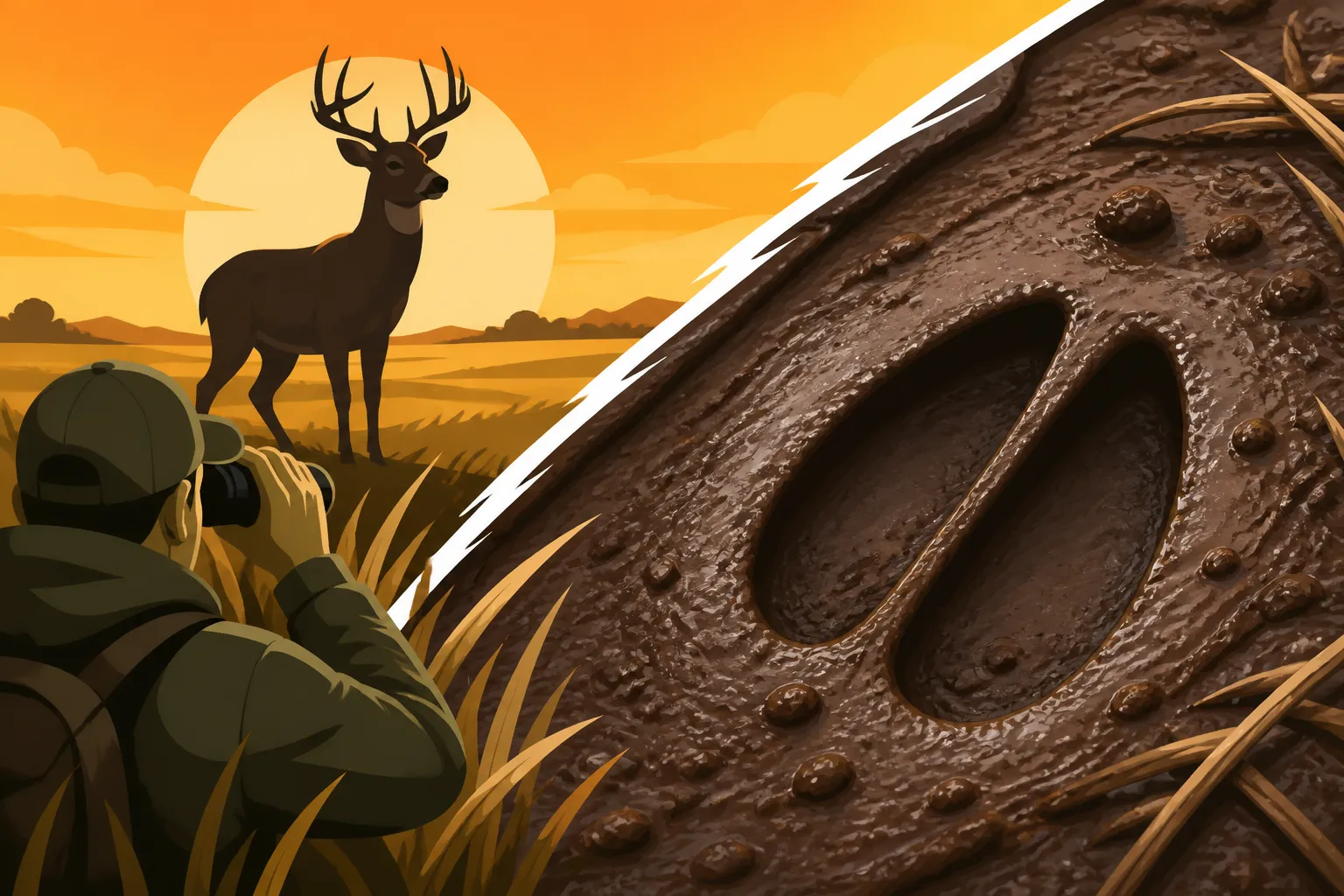
This is where the real detective work begins. A fresh track in mud is a goldmine of information, indicating that a deer was here very recently. The key indicators of a truly fresh track are its sharp, crisp edges. When a deer steps in soft mud, the displaced mud around the print will still be wet and form a clean, undisturbed rim. If there are any loose bits of mud inside the print, they will often still be damp and clinging. If you see tiny air bubbles in the water that might have seeped into the track, that's another strong indicator of recent activity, as the mud is still settling from the weight of the deer.
As time passes, even a few hours, the edges of the track will start to soften and round out due to evaporation from wind and sun. If it rains again, the track might fill with water that looks distinctly different from freshly displaced mud, or if it's been a day or more, debris like dried leaves, dust, or even small insects might have fallen into the print. Look for spiderwebs or small insect tracks across the print itself; if they're there, the track has some age. If the sun has been out, the mud inside the track might appear visibly drier than the mud around it. These subtle changes are your cues, allowing you to prioritize the freshest sign and focus your efforts on areas where deer are actively moving right now. A tool like the GoHunt app can be invaluable here, allowing you to mark fresh sign with precise GPS coordinates, building a real-time map of current deer movement.
Interpreting Track Patterns and Behavior
Finding fresh tracks is one thing, but understanding what those tracks mean is another. Deer aren't just aimlessly wandering; their movements are dictated by survival, food, water, and breeding. The patterns you see in the mud can tell you a compelling story about their current routines and intentions.
Deciphering Travel Lanes and Direction
Deer are creatures of habit, and their tracks often reveal established travel lanes between bedding areas, feeding grounds, and water sources. When you find multiple sets of tracks heading in a consistent direction, especially along natural funnels like creek bottoms, fence lines, or timber edges, you’ve likely found a primary travel route. Pay close attention to the depth of the prints; deeper tracks can indicate a deer carrying more weight (like a mature buck) or moving at a faster pace. Shallow, consistent tracks suggest a leisurely stroll.
To determine direction, look closely at the "push-off" of the hoof. As a deer takes a step, its weight pushes mud forward and slightly upward at the front of the track. The heel end of the track will usually be less disturbed. Also, consider the overall stride. Deer generally step with purpose, so an individual track will usually point in the direction of travel. If you see scuff marks or drag marks behind the print, it often means the deer was slowing down, perhaps approaching a food source or a crossing. Conversely, if the mud is kicked up ahead of the print, it suggests a faster, more urgent movement, possibly indicating a spooked deer. Understanding these directional cues helps you anticipate where a deer is headed and plan your approach, whether it's setting up an ambush or initiating a quiet stalk. This is especially helpful when Reading a Missouri River Bottom for Deer, where tracks can be abundant.
What Track Size and Gait Reveal
The size of a track can give you a good indication of the deer's size and age. Generally, larger, wider tracks belong to mature deer, particularly bucks. Doe tracks tend to be narrower and more pointed. Don’t just look at one track; observe a series of prints to get a sense of consistency. A very large track, coupled with a long stride, almost always points to an older, larger animal, often a buck. These larger bucks tend to be more wary and will often avoid open areas, preferring to stick to thicker cover.
The gait, or manner of walking, is equally informative. A walking deer will leave evenly spaced tracks, usually with the hind foot stepping into or just ahead of the front foot's print. This is typical browsing or general movement. A trotting deer will have longer, more distinct strides with clear spaces between the prints. If you see tracks that are widely spaced and show signs of the deer pushing off with immense power, creating deeper impressions, it’s likely a bounding gait, meaning the deer was spooked or running. During the rut, however, you might see erratic track patterns – a buck chasing a doe, or both moving quickly through an area. Identifying these different gaits in the mud helps you understand the deer's state of mind and immediate activity. A relaxed, walking deer is often catchable, while a bounding deer is long gone.
Beyond Just Hoof Prints: Other Mud-Based Sign
Deer leave more than just tracks in the mud; they leave a whole suite of indicators about their presence and activities. Paying attention to these additional signs will paint an even more complete picture of the deer population in your hunting area. It's about combining all the clues the environment offers.
Muddy Scrapes and Rubs
While rubs are typically found on trees and scrapes in the dirt, mud can actually enhance these signs. A scrape is an area where a buck paws away leaf litter and exposes bare earth, then often urinates over his tarsal glands into the pawed-out area, leaving a strong scent. If you find a scrape in soft, muddy ground, the paw marks will be incredibly clear, indicating a recent visit. The mud itself will be disturbed and wet, perhaps even showing recent urination. If the mud around the scrape is dry but the scrape itself is moist and disturbed, that's a key indicator. Look for a low-hanging branch directly above the scrape, which the buck will rub with his preorbital glands.
Rubs on trees are often thought of as visually distinct, but a buck that has been traveling through muddy areas might leave mud smeared on the tree trunk as he rubs his antlers. The presence of fresh mud on a rub, especially if it’s the same type of mud found on tracks nearby, can confirm recent buck activity. These rubs and scrapes are particularly important during the rut, serving as communication hubs. Finding fresh ones in the mud can tell you precisely when and where a dominant buck is actively seeking does. This ties in directly with anticipating When the North Dakota Rut Peaks and where bucks might be.
Identifying Bedding and Feeding Sign in Mud
Deer spend a significant portion of their day bedding down, and if they're doing so in soft, damp earth, they will leave distinct impressions. A fresh bed in mud will be a noticeable depression that conforms to the shape of a deer's body. The mud inside the bed will be compressed and possibly still damp from the deer's body heat or recently disturbed. If it's old, the mud will be dried and crusty, and leaves or debris might have settled into the depression. Bedding areas are typically located in secure spots with good visibility or dense cover, often on south-facing slopes in winter for warmth or north-facing in summer for coolness.
Feeding sign in mud is usually a bit more subtle but equally telling. If deer are feeding on newly sprouted crops, for example, their tracks will lead directly into the field, and you might see small hoof prints where they’ve stepped on vegetation. If they’re browsing on low-lying shrubs or forbs in a muddy creek bottom, you’ll find tracks alongside freshly nipped-off branches. Pay attention to the quantity and distribution of these feeding tracks; a concentration suggests a favored food source. If you see mud-covered vegetation that's been recently disturbed, it tells you that deer have been actively rooting around or pulling up plants. This could be particularly evident around areas where deer forage for acorns or other mast crops in moist bottomlands. Fresh feeding sign in mud means deer are currently utilizing that area for sustenance, making it a prime location for a stand or blind. This is especially true when Hunting a Shelterbelt Edge for Deer, where feeding deer often leave clear tracks.
Combining Mud Cues with Mapping Tools
In today's hunting world, technology provides incredible advantages. Modern mapping applications, such as GoHunt, allow hunters to overlay satellite imagery, topo maps, and land ownership data right on their phones. When you find compelling mud sign—a fresh track, a hot scrape, or a well-used travel lane—you can immediately drop a waypoint on your digital map. This creates a powerful, real-time record of deer movement.
Imagine you're scouting a new section of PLOTS Land after a rain. You find a series of fresh mule deer tracks skirting the edge of a wheat field, leading into a cluster of thick willows. You mark this with GoHunt. A hundred yards further, you find a large, muddy scrape under an oak tree. Another waypoint. By the end of your scout, you’ve built a comprehensive picture of current deer activity. Later, from the comfort of your home, you can analyze these waypoints, look at prevailing winds, identify natural funnels, and strategize your hunt more effectively. This digital record helps you track trends over days, weeks, and even seasons, showing you how deer shift their patterns based on weather, pressure, and food availability. This level of detail takes the guesswork out of hunting and empowers you to make smarter, more informed decisions in the field.
Strategic Application of Mud Sign in Your Hunt
Now that you've become a master at reading the mud, it's time to put that knowledge to work. Understanding where deer have been is only half the battle; the other half is using that information to predict where they'll be and how to effectively intercept them.
Planning Your Approach Based on Fresh Sign
Once you’ve identified fresh deer movement in the mud, your next steps are critical. If you find hot tracks leading into a thick bedding area, you know those deer are likely still nearby. Instead of busting in blindly, consider a quiet, slow approach from downwind, perhaps circling to get a better vantage point, or Hunting a Coulee Rim at Last Light to catch deer emerging. If the tracks indicate a deer moving casually toward a known food source like a standing cornfield or a green winter wheat plot, you can strategically set up a stand or ground blind along that travel corridor, anticipating their return.
The type of sign also dictates your strategy. A lone, large buck track might mean a stealthy spot-and-stalk is in order, especially if it leads into dense cover. A multitude of smaller tracks heading to a specific field might call for a perimeter setup or a gentle push with a few hunting partners. The mud provides the starting point; your knowledge of deer behavior and the local terrain fills in the rest. Never rush in after fresh sign; take a moment to consider the wind, the time of day, and potential escape routes before making your move.
Understanding the Impact of Weather on Mud Sign
Weather plays a huge role in how mud sign appears and how long it lasts. A light, steady rain can soften the ground perfectly, leaving crisp, clear tracks that are easy to read. A heavy downpour, however, can quickly wash away smaller details, making tracks appear older than they are. Sunshine and wind will dry mud quickly, blurring the edges of prints within hours. Freezing temperatures will turn mud solid, preserving tracks indefinitely, but new movement won't register.
Always consider the recent weather history. If it rained heavily last night and you find fresh, distinct tracks this morning, you know those tracks were made very recently. If it hasn’t rained in days and you find a somewhat faded track that’s still damp in the bottom, it could be from earlier in the week, or it might indicate a low, wet spot that stays muddy longer, a potential water source. The ability to correlate track appearance with recent weather patterns is a crucial skill for accurate interpretation. This allows you to better understand the overall North Dakota Deer Population Estimate and their localized movements.
| Track Freshness | Edge Definition | Water/Moisture | Debris/Vegetation | Context |
|---|---|---|---|---|
| Very Fresh | Sharp, crisp, well-defined rim; mud often still displaced. | Mud inside print is wet, possibly with small air bubbles. | None or minimal, mud appears "clean." | Within 0-3 hours, ideal for immediate pursuit or setup. |
| Fresh | Edges slightly rounded, but still distinct. | Mud inside print damp, perhaps a thin film of water. | Minimal, maybe a few tiny dust particles. | Within 3-12 hours, good for same-day strategy. |
| Recent | Edges noticeably rounded, beginning to flatten. | Mud inside print drying, possibly a crust forming. | Some dust, small leaves, or insect tracks evident. | Within 12-24 hours, still useful for patterning. |
| Old | Edges completely rounded, indistinct. | Mud inside print dry, cracked, or completely filled with debris. | Significant amount of debris, dried leaves, spiderwebs. | 24+ hours, indicates historical movement, not current. |
Mud, Scent, and Deer Sensitivity
Mud isn't just a visual indicator; it also plays a role in scent. Wet ground holds scent much better than dry, hard ground. When a deer walks through mud, it leaves behind not only its physical print but also a strong scent trail from its interdigital glands between its hooves. This means that if you find very fresh tracks in mud, the area will also be rich with residual deer scent.
This heightened scent can be a double-edged sword. On one hand, it tells you that deer are definitely in the vicinity. On the other hand, it means that your scent will also linger more stubbornly on wet ground. This emphasizes the importance of scent control and approaching from downwind. If you're tracking a deer in mud, be excruciatingly careful about your own scent signature. Even if the visual evidence is overwhelming, a careless crosswind can ruin your hunt. Using a detailed map like the GoHunt app to plan your approach with wind direction in mind becomes even more critical when hunting muddy conditions where scent persists longer. Ultimately, mastering the art of White-Tailed Deer Across North Dakota or mule deer hunting means leveraging every piece of information, and mud offers a treasure trove if you know how to read it.
Disclaimer
The information provided in this guide is for educational purposes only and is based on general hunting knowledge and practices in North Dakota. Hunting regulations and conditions can change rapidly. Always consult the official North Dakota Game and Fish Department regulations before heading afield to ensure compliance with all current laws and safety guidelines.