Mule Deer Versus Whitetail Habitat Overlap
It’s a classic North Dakota hunting conundrum, isn't it? You’re out in the field, spotting a deer in the distance, and the first question that pops into your head is: Is that a whitetail or a mule deer? This isn't just about species identification; it profoundly impacts how you approach your hunt, from stalking techniques to understanding their behavior. This guide will dive deep into the fascinating world of whitetail and mule deer habitat in North Dakota, exploring their distinct preferences, the intriguing zones where their worlds collide, and how you can successfully navigate these mixed-habitat challenges as a hunter.
Understanding North Dakota's Deer Species
North Dakota is a treasure trove for deer hunters, offering opportunities to pursue both white-tailed deer and mule deer. While they are both iconic species, they have evolved to thrive in different ecological niches, leading to distinct patterns in their distribution and behavior. Understanding these fundamental differences is the first step in unraveling the complexities of habitat overlap.
The Ubiquitous Whitetail
White-tailed deer are, without a doubt, the most widespread deer species across North America, and North Dakota is no exception. They are incredibly adaptable, a trait that allows them to flourish in a vast array of environments, from dense forests to suburban fringes and, of course, the agricultural mosaic of the North Dakota prairies. Their resilience is a testament to their evolutionary success. If you've spent any time hunting in the state, you've likely seen them in almost every corner.
These deer are masters of cover, preferring areas with dense vegetation where they can easily disappear from view. Their "flagging" white tail, a characteristic they display when alarmed, is a perfect example of their evasive tactics – a visual signal to other deer and a distraction to predators as they bound away into thickets. Their numbers often provide a robust hunting opportunity across the state, making them a primary focus for many hunters. To truly grasp their widespread presence and population trends, you might find insight in our comprehensive guide on White-Tailed Deer Across North Dakota.
The Iconic Mule Deer
In stark contrast to their whitetail cousins, mule deer embody the rugged, open landscapes of western North America. In our state, they are primarily associated with the dramatic, broken terrain of the Badlands, though their range can extend into other areas with suitable habitat. Mule deer are renowned for their large, mule-like ears and their distinctive "stotting" or "pronking" gait, a four-legged bounding escape mechanism that is perfectly suited for traversing uneven ground.
Their reliance on specific types of terrain means their distribution is much more localized compared to whitetails. Hunting mule deer often involves glassing vast expanses and long stalks, a different challenge than the brush-busting tactics common for whitetails. The health of the North Dakota's Mule Deer Range is a constant topic of discussion among hunters and wildlife managers alike, as these majestic animals face unique challenges in their more specialized habitats. These deer represent a true Western hunting experience right here in North Dakota.
Distinct Habitat Preferences of Whitetails
While both species are cervids, their day-to-day lives are dictated by profoundly different needs, especially concerning the type of cover, food, and security they seek. Recognizing these core preferences is crucial for predicting where you'll find each species.
River Bottoms and Agricultural Edges
White-tailed deer are absolute champions of utilizing riparian corridors and the edges of agricultural fields. Along the winding rivers like the Missouri, James, or Souris, you'll find dense stands of cottonwoods, willows, and various shrubs that provide perfect cover, bedding areas, and a consistent food supply. These river bottom areas are often insulated from the harsh prairie winds, offering critical shelter during North Dakota's notoriously brutal winters. A hunter looking for whitetails would be wise to spend time Reading a Missouri River Bottom for Deer, focusing on transition zones and thick escape routes.
Furthermore, whitetails thrive on the bounty provided by North Dakota's vast agricultural landscape. Cornfields, sunflower fields, and alfalfa patches are not just food sources but also offer incredible cover, especially in the late season. Deer will stage in nearby woodlots or dense creek bottoms and move into these fields to feed, particularly at dawn and dusk. This preference for food-rich, cover-dense areas makes them a common sight on private land bordering these agricultural zones, often creating consistent travel patterns that hunters can exploit.
Shelterbelts and Pothole Country
Beyond the major river systems, North Dakota's prairie pothole region, characterized by numerous wetlands and small woodlots, provides another prime whitetail haven. The planted shelterbelts, rows of trees originally designed to protect homes and fields from wind, have become invaluable linear oases for whitetails, offering thermal cover and travel corridors across otherwise open landscapes. These man-made features are often magnets for deer activity, especially when they connect to other patches of cover or food.
The "pothole country" itself, dotted with thousands of small wetlands and sloughs, provides excellent bedding cover in the cattails and dense grasses surrounding these water bodies. Whitetails will use the edges of these potholes, especially those with some brushy cover, for bedding and security during the day. This fragmented landscape offers a complex mosaic of cover and food that whitetails expertly exploit, making it an excellent area to focus your scouting efforts if you're targeting these adaptable deer. Understanding how deer utilize these features is key to success on the prairie, often demanding a different approach than hunting in timbered regions.
Mule Deer's Domain: The Badlands and Beyond
Mule deer, with their large ears and distinctive bounding gait, are perfectly adapted to the rugged, wide-open spaces that define their primary range in North Dakota. Their preferences starkly contrast with whitetails, demanding a different hunting mindset and strategy.
Rugged Badlands Terrain
When you think of mule deer in North Dakota, the dramatic, eroded landscapes of the Badlands immediately come to mind. This is their kingdom. The deep coulees, steep buttes, and rolling grasslands interspersed with pockets of juniper and ponderosa pine provide the perfect blend of cover, browse, and escape routes for these animals. Mule deer don't rely on dense, continuous cover in the same way whitetails do; instead, they use the topography itself as their primary form of concealment. The sheer ruggedness of the Badlands offers endless folds and draws for them to disappear into, even when seemingly exposed.
Glassing is paramount in this terrain. Hunters spend countless hours behind powerful optics, systematically scanning the vast landscapes, looking for the tell-tale shape of a mule deer against the muted colors of the Badlands. Once spotted, a successful stalk often requires navigating steep, broken ground, utilizing every rise and depression to stay out of sight. Learning Where Badlands Bucks Bed is a fundamental skill, as these locations often offer elevated positions for security and quick escape. The physical demands of hunting this habitat are significant, but the rewards of spotting a mature mule deer buck in such an awe-inspiring setting are unparalleled.
Open Prairie and Breaks
While the Badlands are the quintessential mule deer habitat, their range can extend eastward into the more rolling, open prairie country, particularly in areas with significant breaks, draws, and larger tracts of native grassland. These regions, though less dramatic than the Badlands, still offer the wide-open spaces mule deer favor, along with the scattered pockets of brush and taller grasses that provide bedding and protection.
In these more subtle landscapes, mule deer still utilize elevation and contours for cover. A deep, brushy draw cutting through otherwise flat prairie can be a significant travel corridor and bedding area. They are often found on the south-facing slopes in winter, soaking up the sun's warmth. The availability of food and water sources within these breaks also plays a critical role in their distribution. Hunters in these transitional zones need to be equally proficient with their optics, as deer can appear and disappear quickly within the undulations of the prairie. The ability to spot Pronghorn on North Dakota's Open Prairie is a similar skill set to finding mule deer in this type of habitat, requiring patience and a keen eye for subtle movement and shapes.
Where Worlds Collide: Overlap Zones and Ecotones
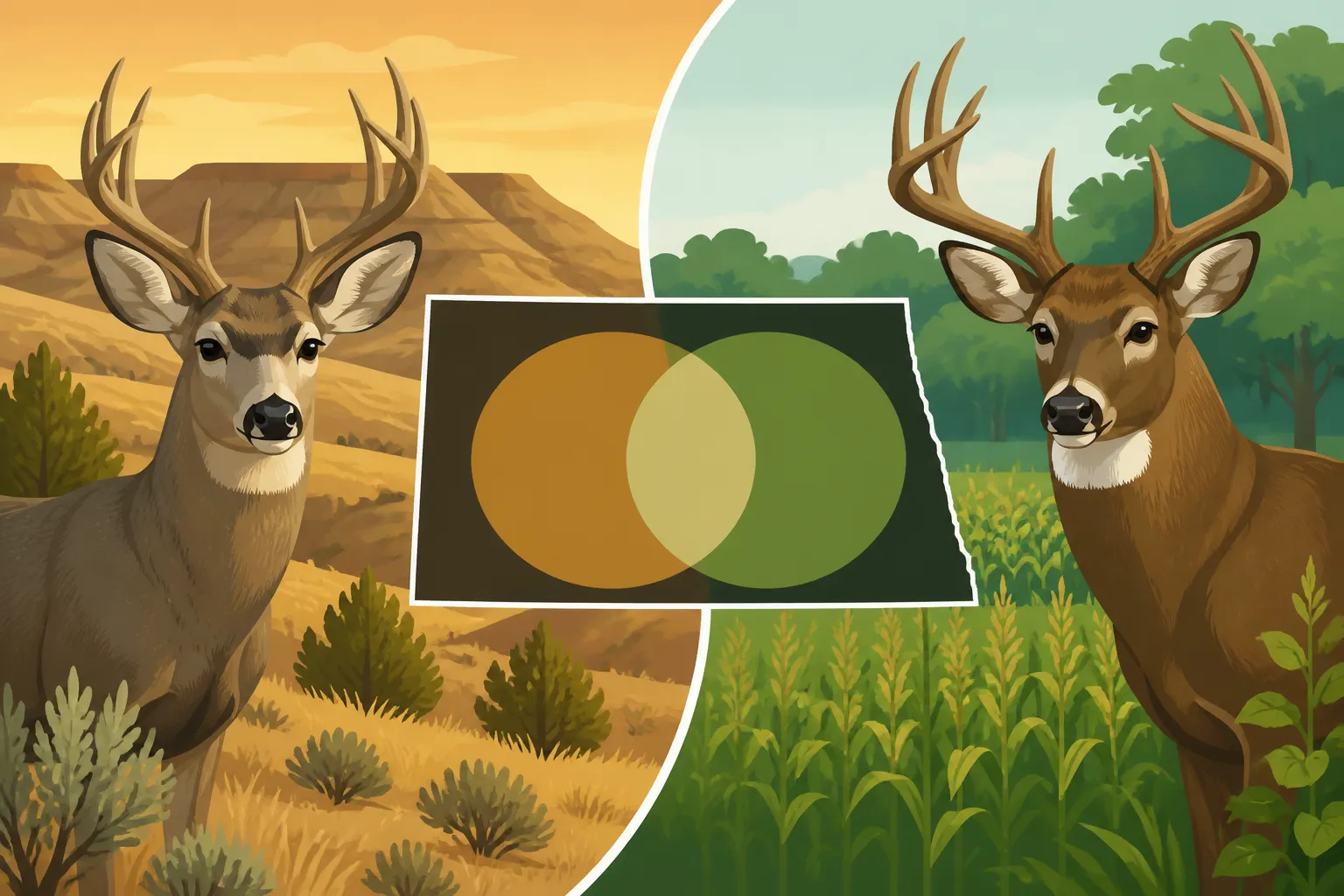
The fascinating aspect of North Dakota's deer hunting landscape is that the distinct habitats of whitetails and mule deer aren't always neatly separated by imaginary lines. There are dynamic, intriguing zones where their ranges meet, mingle, and even temporarily overlap. These "ecotones" or transition areas present unique challenges and opportunities for hunters.
Missouri River Corridor's Unique Blend
Perhaps the most prominent and complex overlap zone in North Dakota is the mighty Missouri River corridor. This river system, with its thick bottomland timber, dense river breaks, and adjacent agricultural fields, offers suitable habitat for both species. Whitetails thrive in the dense cover and food-rich fields, while mule deer will often utilize the more open, broken bluffs and coulees that feed into the main river valley. It’s not uncommon to glass a whitetail buck in a willow thicket along the riverbank only to spot a mule deer buck cresting a distant bluff overlooking the same river.
This creates a unique scenario where a single hunting area can hold both species, sometimes within mere hundreds of yards of each other. Hunters who learn to adapt their scouting and tactics for both whitetails and mule deer stand the best chance of success here. The diverse terrain requires versatility; you might be still-hunting dense timber one moment and glassing open bluffs the next. Knowing the subtle signs and preferred micro-habitats of each species within this blended environment is paramount. Understanding how to navigate and hunt this area is crucial, which is why we have a detailed guide on Hunting North Dakota's Missouri River Corridor.
Transitional Prairie-Badlands Fringe
Another significant overlap zone occurs on the fringe where the rolling prairie begins its dramatic descent into the Badlands. Here, the landscape transitions from open grasslands and agricultural fields to the characteristic buttes, coulees, and draws of the Badlands. Whitetails, always pushing the boundaries, will often venture into the lower, brushier draws and pockets of timber within the Badlands proper, especially if they are close to preferred food sources on the prairie. Conversely, mule deer might move out of the more rugged terrain to feed in adjacent grain fields or utilize brushy draws that extend further into the prairie.
This "fringe" habitat is a puzzle for hunters. You might find whitetail rubs in a deep coulee that also shows sign of mule deer activity. It's a testament to the adaptability of both species, particularly when resources are abundant or pressure is high. For hunters, this means keeping an open mind and being prepared for either species when scouting or setting up. Using tools like the GoHunt app to study the topography and land ownership can help you pinpoint these subtle transition areas, allowing you to maximize your chances of encountering either species. These areas require careful observation to pick up on the subtle clues left by each deer type.
Man-Made Habitat Bridges
Beyond natural ecotones, human development, particularly agriculture, can inadvertently create "habitat bridges" that encourage overlap. Large tracts of standing corn or sunflower fields, even those relatively far from traditional mule deer country, can provide such exceptional cover and food that mule deer will temporarily utilize them, especially during the fall. This is particularly true if these fields are adjacent to a draw or a pocket of timber that offers some measure of typical mule deer security.
Similarly, extensive shelterbelt systems, while typically whitetail magnets, can sometimes extend into or near areas where mule deer range, drawing them out of their typical cover. This phenomenon is less about a permanent shift in habitat preference and more about opportunistic use of high-value resources. A hunter might be Hunting Standing Corn for Late-Season Geese and unexpectedly jump a mule deer buck that has found refuge and food within the dense stalks. This highlights the importance of never making assumptions and always observing the specific conditions of a hunting area, as both species can surprise you.
Hunting Strategies for Overlap Areas
Successfully hunting in North Dakota's mule deer and whitetail overlap zones demands flexibility, keen observation, and a willingness to adapt your approach. It's not about having one fixed strategy, but a toolbox of tactics you can deploy depending on the specific terrain and deer sign you encounter.
Scouting for Mixed Sign
Before you even step foot in the field with your weapon, your boots-on-the-ground scouting, augmented by digital tools, becomes paramount in overlap areas. You're not just looking for "deer sign"; you're actively searching for both whitetail and mule deer sign. This means identifying distinct tracks – whitetail tracks tend to be more pointed, while mule deer tracks are often rounder. Pay attention to rub lines: whitetails typically rub smaller trees and saplings, often stripping bark completely, while mule deer might rub larger, sturdier trees, leaving more polished, less destructive marks. Scrapes are primarily a whitetail behavior, but don't rule out finding them in transitional areas.
Using mapping apps like GoHunt is invaluable. Layers that show topography, vegetation types, and satellite imagery can help you identify those subtle transition zones where whitetail-friendly cover meets mule deer terrain. Look for areas where dense river bottom timber gives way to open, broken bluffs, or where agricultural fields butt up against a badlands draw. Pre-season scouting, even without deer present, can reveal travel corridors, bedding areas, and pinch points that both species might use. Understanding the North Dakota Deer Population Estimate for your chosen unit, and whether it favors one species, can also help focus your efforts.
Adapting Tactics on the Fly
Once you're in the field, the ability to adapt your hunting style is crucial. If you're working a river bottom thicket and find fresh whitetail tracks and rubs, you might switch to a more stealthy, still-hunting approach, slowly slipping through the cover. However, if that thicket opens up into a series of open, rolling hills, and you spot what looks like mule deer sign, you'll need to transition to glassing and potentially a spot-and-stalk approach.
This often means carrying the right gear for both scenarios, which we'll discuss next. But it's also a mindset. Don't get locked into "I'm hunting whitetails today" or "I'm hunting mule deer today." In overlap areas, you're hunting deer. Be prepared to sit patiently in a ground blind overlooking a field edge in the morning, then transition to hiking ridges and glassing coulees in the afternoon. Flexibility is your best friend when faced with the potential for either species to appear. This is especially true when attempting to distinguish between a Badlands Versus Prairie Pothole Deer, as their habits even within a species can vary by region.
Gear Considerations for Diverse Terrain
Since you'll be navigating varied landscapes and potentially shifting your hunting style, your gear choices become even more critical. Here's a quick table to illustrate some key considerations:
| Gear Item | Whitetail Overlap Focus | Mule Deer Overlap Focus |
|---|---|---|
| Optics | 8-10x Binoculars, potentially a rangefinder | 10-15x Binoculars, Spotting Scope, Rangefinder |
| Footwear | Sturdy, waterproof boots for mud and brush | High-ankle, stiff-soled boots for steep, rocky terrain |
| Clothing | Layered, quiet fabrics for still-hunting and sitting | Durable, breathable layers for hiking, good wind protection |
| Pack | Medium-sized day pack for essentials | Larger day pack for extra water, food, spotting scope, quartering tools |
| Weapon System | Versatile rifle (e.g., .30-06, .270) or Bow/Crossbow | Accurate rifle (.270, .300 WM, 6.5 Creedmoor) for longer shots, bipod |
| Navigation | GPS device or smartphone app | GPS device, detailed topographical maps, GoHunt app |
In addition to the basics, consider carrying a lightweight treestand if you anticipate an opportunity for a whitetail sit in timber, but also be prepared with a comfortable sitting pad and bipod for prone shots if glassing vast expanses for mule deer. The goal is to be agile and ready for whatever opportunity presents itself. For archery hunters, a deep dive into Bowhunting North Dakota's Long Archery Season might offer specific bowhunting gear insights for varying terrain.
Identifying Deer in Mixed Habitat
The moment of truth often comes when you spot a deer, and you have mere seconds to make a positive identification. In overlap zones, this can be particularly challenging as both species can exhibit some variation within their physical characteristics. Knowing the key distinguishing features and behavioral patterns is crucial.
Physical Characteristics and Distinguishing Features
While there are many similarities, several key physical traits can help you differentiate between a whitetail and a mule deer, especially in an overlap area.
- Ears: This is often the most obvious differentiator. Mule deer have significantly larger, "mule-like" ears that are typically half the length of their head or more. Whitetail ears are smaller and more proportionate to their head size.
- Antlers: Whitetail antlers typically grow from a single main beam, with individual tines branching off that beam. Mule deer antlers are often bifurcated, meaning each beam forks, and then forks again, creating a "Y" shape. However, genetic variations and age can sometimes make this tricky, particularly with younger bucks or atypical racks.
- Tail: The tail is a dead giveaway, especially when the deer is alarmed. Whitetails have a broad, dark brown tail with a bright white underside that they "flag" high in the air when fleeing. Mule deer have a narrow, rope-like tail that is typically white with a black tip, and they generally hold it down when running, though they might swish it.
- Coloration: While both species can vary in color, mule deer tend to have a more grayish-brown coat, especially in winter, often with a white rump patch. Whitetails are usually a reddish-brown in summer, transitioning to a grayer brown in winter, without the prominent white rump patch of a mule deer.
- Rump Patch: As mentioned, mule deer typically have a distinct white rump patch, often extending up to the base of their tail. Whitetails generally do not have this prominent white patch on their rear.
- Facial Features: Mule deer often have a distinctive black patch on their forehead and a white patch around their muzzle and eyes, giving them a more "mask-like" appearance. Whitetails usually have a more uniform brown face with a white band across the nose and around the eyes.
It takes practice, but focusing on these key features can usually provide a solid identification. When in doubt, let the deer walk, or use your optics to get a clearer view. Sometimes, you'll see a buck that looks like a hybrid. These can be particularly confusing, but usually, one set of traits will dominate.
Behavioral Differences in Overlap Zones
Beyond physical traits, the way a deer behaves can offer strong clues, especially when they are in an area where both species exist.
- Gait/Movement: This is a major tell. When alarmed, a mule deer's unique "stotting" or "pronking" gait – bounding on all four feet simultaneously – is unmistakable. They seem to spring into the air, perfectly suited for covering rough, broken ground. Whitetails, on the other hand, will typically run in a more fluid, graceful manner, using explosive bursts of speed and weaving through cover, often flagging their tail prominently as they go.
- Flight Response: Whitetails are masters of evasion and cover. When spooked, they will often run a short distance into the thickest available cover and then stop, trying to determine if the threat is still present. Mule deer, while still using cover, are more inclined to put distance between themselves and the threat, using their bounding gait to quickly clear open ground and gain elevation to assess the situation.
- Habitat Use Patterns: Even in overlap zones, deer tend to revert to their species-specific preferences. If you see a deer consistently using a dense shelterbelt or a thick creek bottom, it's more likely a whitetail. If it's constantly on the more open, broken bluffs or disappearing into a steep coulee, it leans towards being a mule deer. Observe where they are and how they move within that micro-habitat.
- Social Structure: While not always obvious, whitetails tend to form smaller, tighter family groups, while mule deer can sometimes be found in larger, looser herds, especially does and fawns. Buck groups can vary, but these general tendencies can sometimes offer a subtle hint.
By combining careful observation of both physical traits and behavioral patterns, you can significantly improve your ability to identify the deer you're seeing in North Dakota's fascinating habitat overlap zones. This knowledge not only enhances your hunting strategy but also deepens your appreciation for these incredible animals and the diverse landscapes they call home. When analyzing movement and behavior, particularly the North Dakota Deer Harvest Records, you can often see patterns that reflect these distinct species tendencies across different units.
Disclaimer
Hunting is an activity that carries inherent risks. Always prioritize safety, adhere to all local and state regulations, and respect private property. The information provided in this guide is for informational purposes only and should not replace proper hunter education or professional guidance. Always consult the latest North Dakota Game and Fish Department regulations before planning your hunt, as rules and conditions can change.